

Tech Giants Pour Billions into Clean Energy as AI Demand Creates Unexpected Green Revolution
Global, Tuesday, 7 April 2026.
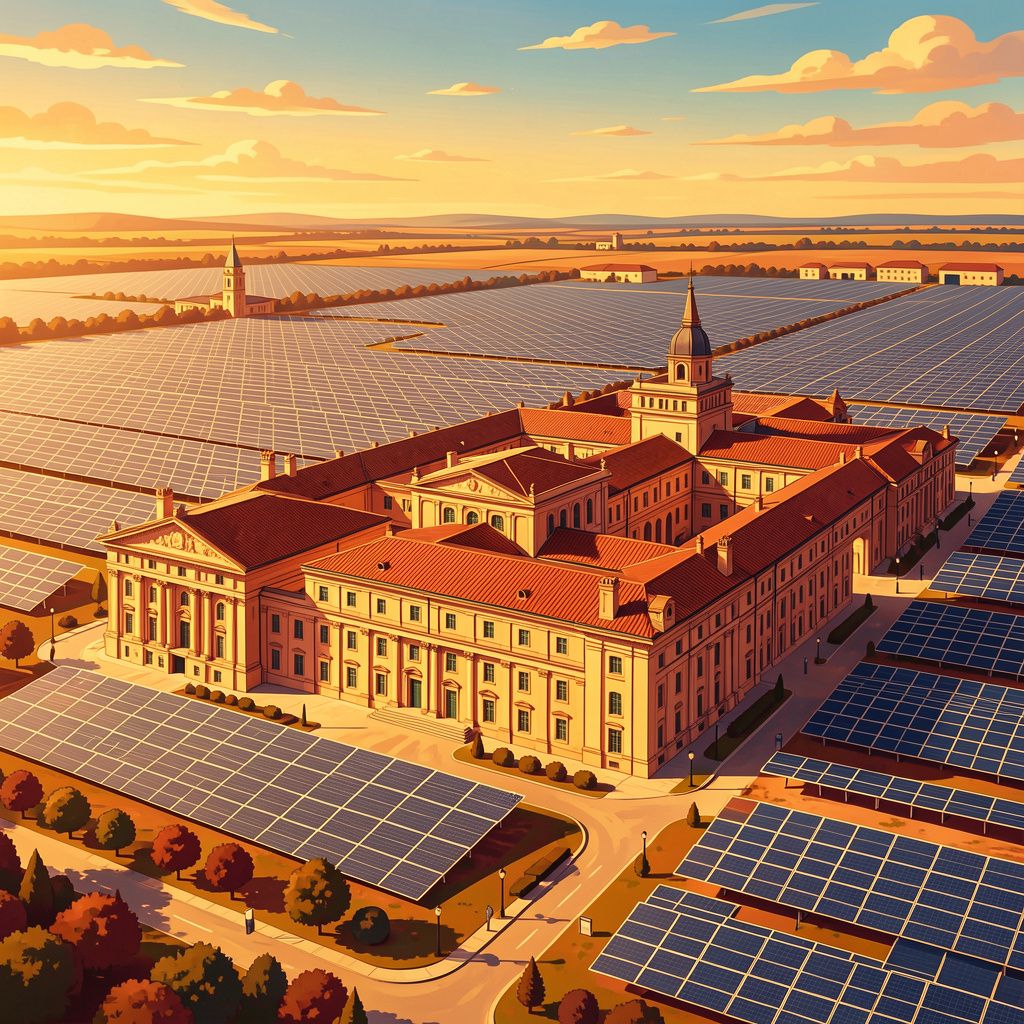
Major technology companies are driving unprecedented renewable energy investments to power artificial intelligence infrastructure, with hyperscalers contracting nearly 30 GW of wind and solar capacity globally in just one year. Despite rising emissions from AI data centers—Google’s jumped 50% while Microsoft’s increased 23%—this AI boom is accelerating clean energy adoption faster than anticipated, positioning renewable sources as critical for computational growth and reshaping energy markets worldwide.
Record Energy Procurement Drives Clean Transition
From February 2025 to February 2026, the four major hyperscalers—Amazon, Google, Microsoft, and Meta—contracted an extraordinary 19.4 GW of wind and solar capacity in the United States, with an additional 10 GW secured internationally [1]. This massive procurement represents a fundamental shift in how technology companies approach energy sourcing, driven by the computational demands of artificial intelligence workloads. An additional 7 GW of capacity was added to the US database in February 2026 to account for unknown technology breakouts, with 3 GW added internationally [1], indicating the scale of clean energy investments continues to accelerate beyond initial projections. By 2025, approximately 67% of energy used in data centers came from renewable sources [1], demonstrating significant progress despite the challenges posed by rapidly expanding AI infrastructure.
Smart Grid Solutions Address AI Energy Bottleneck
The energy bottleneck constraining AI development is being addressed through innovative grid optimization rather than traditional infrastructure expansion. Stanford research reveals that advanced economy grids operate at just 30% utilization [2], suggesting massive untapped potential. A 1% improvement in grid flexibility could unlock 100 GW in the United States, equivalent to $500 billion in avoided infrastructure costs [2]. Microsoft CEO Satya Nadella highlighted the urgency of this challenge, stating that Microsoft has “GPU clusters sitting idle – depreciating assets waiting for power that may not arrive for years” [2]. Meanwhile, Sam Altman is pushing to build a gigawatt of new AI infrastructure every week [2], underscoring the unprecedented scale of energy demand from AI applications. GridCARE’s partnership with Portland General Electric has demonstrated that hundreds of megawatts of computing capacity can be accelerated years ahead of original timelines without building new generation or transmission [2]. Their analysis shows that a 1 GW data center utilizing spare grid capacity can reduce rates for average consumers by as much as 5%, or $100 per year [2].
Emissions Rise Despite Clean Energy Push
Despite record renewable energy procurement, major technology companies are struggling to contain their overall carbon emissions as AI demands surge. Google’s emissions jumped nearly 50%, Amazon’s rose by 33%, Microsoft’s increased more than 23%, and Meta’s climbed more than 60% over roughly the first five years of their climate commitments [4]. Data centers consumed about 4.6% of total U.S. electricity in 2024, with natural gas accounting for more than 40% of electricity powering U.S. data centers [4]. The situation could worsen significantly, as data center electricity use could nearly triple by 2028 [4]. Patrick Huang, a senior analyst at Wood Mackenzie, observed that tech companies are “starting to acknowledge that, ‘Yeah, we’re maybe not on track’” regarding their sustainability goals [4]. A study by the Rhodium Group found AI is partially blamed for a 2.4% uptick in U.S. fossil fuel emissions in 2025 [4]. Julie McNamara, associate policy director at Union of Concerned Scientists’ Climate & Energy program, warned that “each of these alone could be real challenges. Together, it’s just creating a real near-term crunch on the system” [4].
AI Transforms Energy Workforce and Market Projections
The convergence of artificial intelligence and renewable energy is reshaping employment landscapes and market valuations across the clean energy sector. The AI in energy market is projected to reach $46.92 billion in the next five years and increase by 317.3% by 2034 compared to 2025 [3]. In 2022, over 13 million people were employed in the renewable energy sector globally, an increase from approximately 12.7 million in 2021, with solar and bioenergy accounting for more than half of these jobs [3]. By 2030, the market for big data specialists will increase by 35% compared to 2025 [3]. The UK, Germany, and France currently have the highest number of green-AI talent, according to a February 2026 Interface report using data from September 2025 [3]. AI is transforming energy systems by optimizing charging networks, enabling real-time emissions tracking, and creating entirely new career paths that combine traditional energy expertise with advanced digital capabilities. The demand for data engineers and professionals who can merge energy knowledge with digital tools is growing rapidly, while automation simultaneously replaces repetitive tasks throughout the sector.