

YouTube's AI System Takes Down Nvidia's Own Product Announcement After Copyright Confusion
Rome, Tuesday, 7 April 2026.
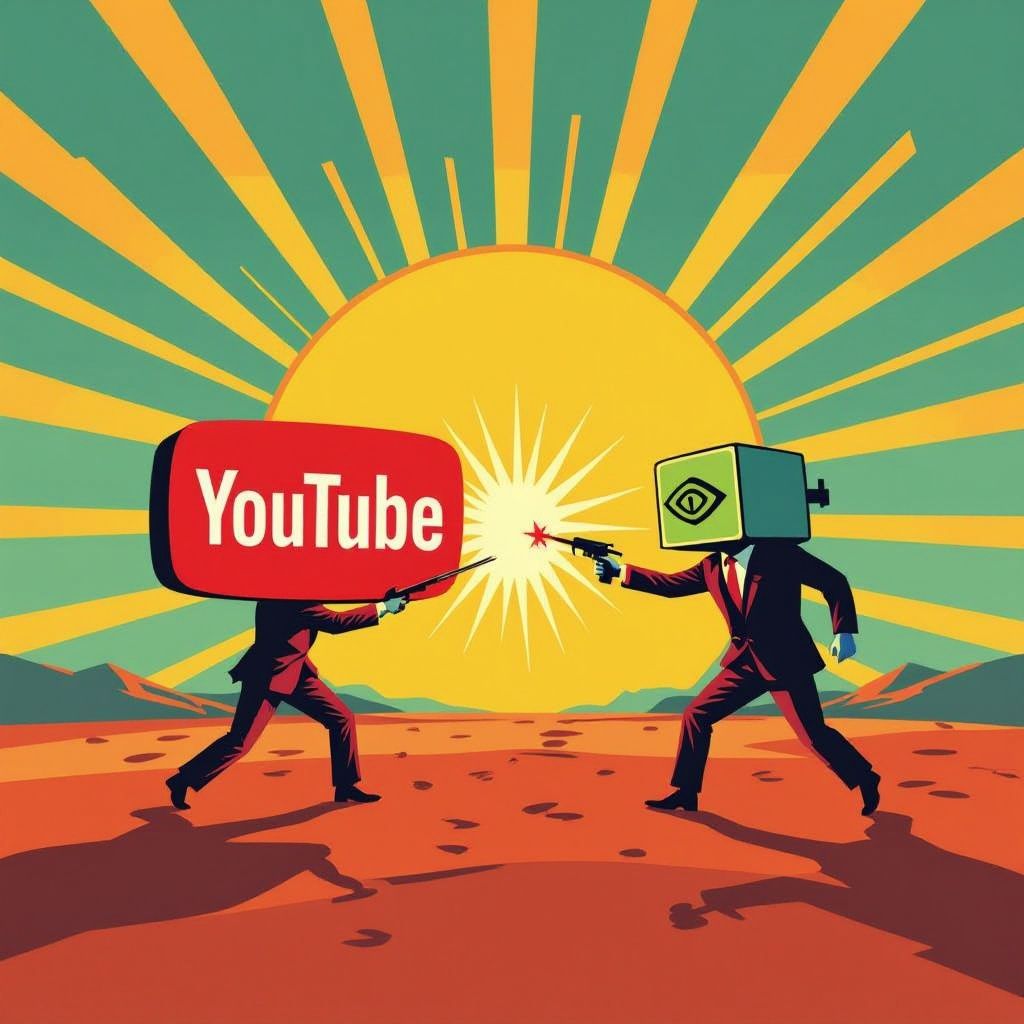
YouTube’s automated copyright detection mistakenly removed Nvidia’s official DLSS 5 announcement video in Italy after an Italian TV channel filed blanket copyright strikes against all videos using the same trailer footage. The ironic twist: the TV channel had used Nvidia’s own promotional material in their broadcast, then claimed ownership over it, triggering mass takedowns across the platform including the original source.
The Copyright Strike Chain Reaction
The incident unfolded on April 6, 2026, when Italian broadcaster La7 filed a mass DMCA complaint against YouTube videos containing footage from Nvidia’s DLSS 5 trailer [1][7]. The television channel had used portions of Nvidia’s promotional material in their own news broadcast on April 4, 2026, but then claimed copyright ownership over the content, targeting every video on the platform that featured the same footage [1][7]. This sweeping action triggered YouTube’s AI-powered content moderation system, which automatically removed not only Nvidia’s original announcement video but also content from smaller creators who had used the trailer for reaction videos and analysis [1]. Gaming content creator Destin Legarie documented the timeline, noting he had posted his video on March 16, 2026, while La7 used his footage weeks later on April 4, 2026, before filing the copyright claim [7].
Understanding DLSS 5: Nvidia’s Semiconductor Innovation
DLSS 5 represents Nvidia’s latest advancement in the semiconductor industry, specifically in AI-powered graphics processing technology [3][4]. The Deep Learning Super Sampling technology uses neural rendering to calculate photorealistic lighting and material effects, processing color and motion vectors from each frame to enhance visual quality [4]. Nvidia defines DLSS 5 as ‘the most significant advancement in computer graphics since the debut of real-time ray tracing in 2018’ [3]. The technology can improve lighting and three-dimensional photorealistic materials while reproducing complex contact shadows, light effects, and detailed textures of hair, skin, and fabrics [3]. Unlike previous DLSS versions that focused primarily on performance gains while preserving visual fidelity, DLSS 5 fundamentally modifies the visual output of games through its neural rendering approach [4]. The technology incorporates Dynamic Multi-Frame Generation capabilities that can generate up to 6 frames for every rendered frame, with AI potentially generating 23 out of 24 visible pixels [4].
AI Moderation’s Broader Impact on Content Creation
The incident highlights the growing influence of automated content moderation systems across digital platforms. YouTube’s AI technology serves as the first line of defense in content moderation, with the platform stating that ‘AI classifiers help detect potentially violative content at scale, and reviewers work to confirm whether content has actually crossed policy lines’ [1]. The scale of AI-driven enforcement is substantial: in 2025, YouTube terminated over 12 million channels for violating terms of service, with the majority flagged by AI systems [1]. However, the Nvidia case demonstrates how these automated systems can create false positives that affect legitimate corporate communications and smaller content creators alike. As of April 5, 2026, Nvidia had not yet successfully reinstated its video, while smaller creators faced additional challenges in appealing the takedowns and risked receiving account strikes [1][6]. TeamYouTube acknowledged the dispute process, noting that claimants have 30 days to respond to appeals, and that copyright owners who repeatedly make erroneous Content ID claims can have their access disabled [8].
Market Implications and Resolution Timeline
The copyright controversy adds another layer to the already contentious reception of DLSS 5, which had generated significant criticism since its March 2026 announcement at GTC 2026 [3][4]. Critics have labeled the technology ‘AI Slop,’ expressing concerns about artistic standardization and the potential flattening of visual aesthetics in gaming [4][8]. Nvidia CEO Jensen Huang responded to these criticisms, stating ‘We created the technology, not the art’ and ‘whoever disputes the technology is completely wrong’ [3]. The video had accumulated 2.3 million views before the copyright takedown, and according to third-party extension data, it received overwhelmingly more dislikes than likes [7][8]. After several hours of disputes, La7 released all the disputed videos on April 4, 2026 [7]. As of April 5, 2026, Nvidia’s DLSS 5 announcement became viewable again in Italy and globally, though Nvidia has not issued any official statements about the copyright issues [7]. The company plans to release the generative AI-based DLSS 5 technology later in 2026 [7], positioning it as a competitive advantage in the semiconductor industry’s ongoing AI integration race.
Bronnen
- www.tomshardware.com
- www.instagram.com
- www.sentieriselvaggi.it
- tech.everyeye.it
- www.instagram.com
- letsdatascience.com
- dotesports.com
- www.inkl.com