

The Netherlands Expands Its Clean Energy Network
Rotterdam, Sunday, 22 November 2026.
Despite costs doubling to 3.8 billion euros, the Dutch national hydrogen network is advancing northward, repurposing gas pipelines to connect major industrial hubs by 2033.
Strategic Industrial Corridors and Cross-Border Ambitions
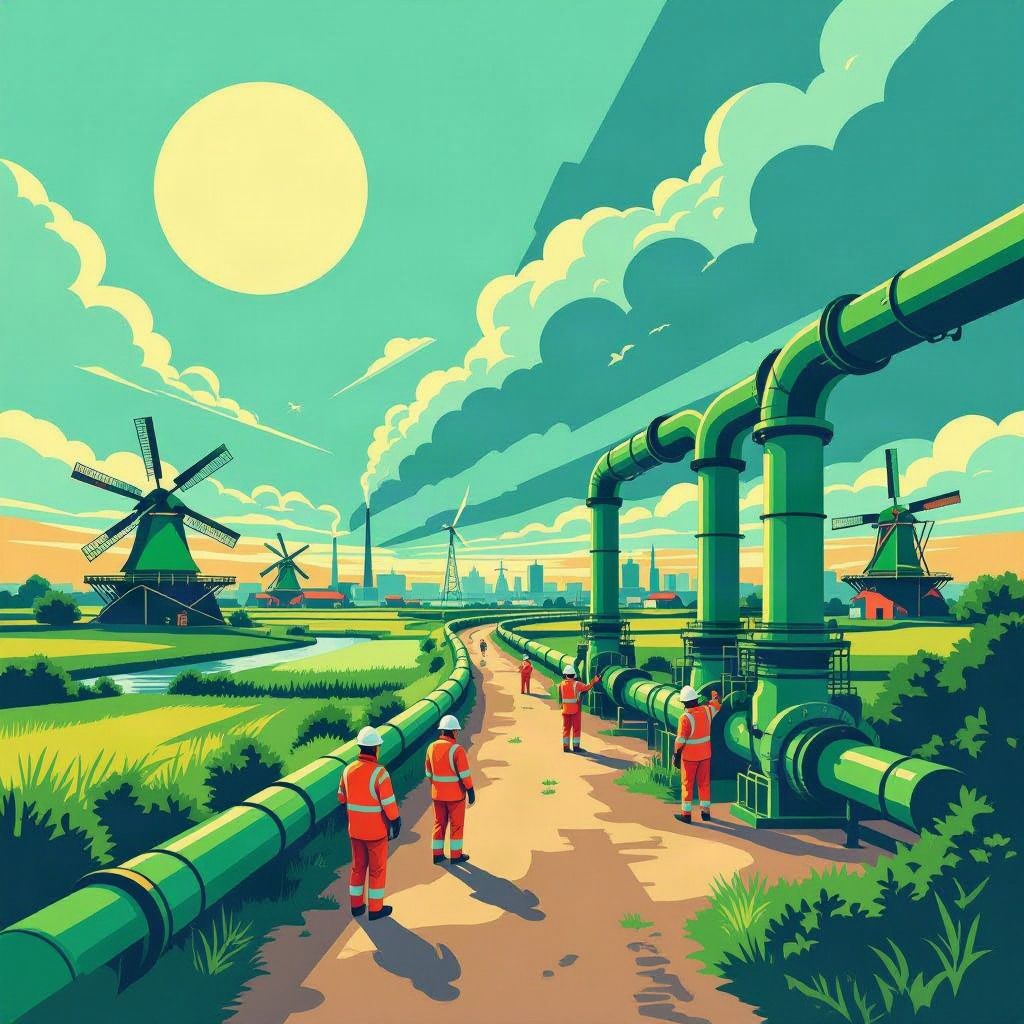
The push to establish the Netherlands as Northwestern Europe’s premier clean energy hub centers on a comprehensive infrastructure initiative designated by the Dutch cabinet on 29 June 2022 [2]. Gasunie subsidiary Hynetwork Services was appointed to construct and manage the Waterstof Netwerk Nederland (WNL), a dedicated 1200 km national network designed to integrate five major domestic industrial clusters, inland production facilities, import terminals, and cross-border corridors to Germany and Belgium [2][3]. The commercial foundation began taking concrete form in May 2026, when King Willem-Alexander officially opened the first 32 km segment of pipeline running between Maasvlakte 2 and Pernis in the port of Rotterdam [1][2]. By repurposing existing natural gas pipelines alongside freshly excavated conduits, the state-backed initiative intends to replace fossil fuel inputs with green hydrogen across chemical processing, metallurgy, and heavy logistics [1][2].
Northern Expansion Enters Critical Administrative and Engineering Phases
Following the opening of the southwestern port segment, the WNL project has shifted significant operational focus toward the northern provinces [2]. As of 19 November 2026, formal plans for the regional corridor covering Drenthe and portions of Overijssel have been made available for public inspection, while the regulatory documentation for the Groningen section is slated to follow in early 2027 [2]. Construction across the Northern Netherlands is scheduled to start in 2027 and reach operational completion by 2030, keeping the wider national backbone on course toward a target completion date of 2033 [alert! ‘Northern timeline hinges on 2027 permit approvals without judicial delays’] [2]. This northern trunk specifically targets regional industry clusters situated in Eemshaven, Delfzijl, and Emmen [2]. While the Tjuchem to Ommen segment will largely reuse legacy natural gas pipelines, the link between Tjuchem and Eemshaven will consist entirely of newly installed pipelines engineered with a larger diameter to handle projected off-take volumes [2].
Capital Allocations and Technical Execution Across Varied Landscapes
The realization of this extensive infrastructure carries significant financial and operational complexities [1][8]. Capital expenditure requirements for the national hydrogen pipeline network have escalated substantially, more than doubling to an estimated 3.8 billion euro [1]. To manage the commercial and regulatory parameters across various regional subsections, Gasunie has expanded project management teams, including recruiting contract management specialists tasked with mitigating risk, managing framework agreements, and supervising delivery across engineering, procurement, and environment divisions [3]. Further mechanical engineering demands are supported by specialized engineers overseeing pipeline stations and installations, commanding annual compensation packages between €70.836 and €96.841 to direct preliminary and detail designs [6]. Meanwhile, specialized consultancy firms like EIFFEL Projects supply environmental managers earning €4.500 to €6.500 gross per month to align stakeholder relations with local municipalities and water authorities [5].
Pipeline Engineering Techniques and Broader Market Horizons
To minimize environmental and agricultural disruption throughout rural tracts, Hynetwork deploys four distinct installation methodologies [8]. While open excavation remains the primary technique, operating within a working strip measuring between 15 and 50 meters wide with groundwater dewatering, contractors also use soil displacement plowing equipped with sensor probes, allowing disturbed grasslands to recover within 2 to 3 days [8]. When navigating sensitive ecosystems or built infrastructure, crews rely on trenchless methods including Horizontal Directional Drilling (HDD) with entry angles of 8 to 12 degrees, and Arch Boring Methods (BBM) which achieve working pressures 5 to 10 times lower and flow rates roughly 50% lower than standard HDD, substantially mitigating blowout risks [8]. These pipelines are already being fed by alternative supply chains; U.S. clean energy firm Plug Power recently transported 32 tons of green hydrogen across the border from Germany to Gasunie using more than 30 tube trailers [4]. Although the national court of audit (Rekenkamer) has cautioned that broader national hydrogen targets demand a reality check amid market hesitation, the phased delivery of pipeline capacity through 2033 remains the central pillar in scaling Dutch industrial decarbonization [1][2].
Bronnen
- www.nu.nl
- zakenn.nl
- interex.nl
- www.wattisduurzaam.nl
- www.jobleads.com
- myprivacy.dpgmedia.nl
- www.stad-en-groen.nl
- energietransitie.nl