

Scientists Turn Agricultural Waste Into Medicine Ingredients Using Only Electricity
Wageningen, Thursday, 9 April 2026.
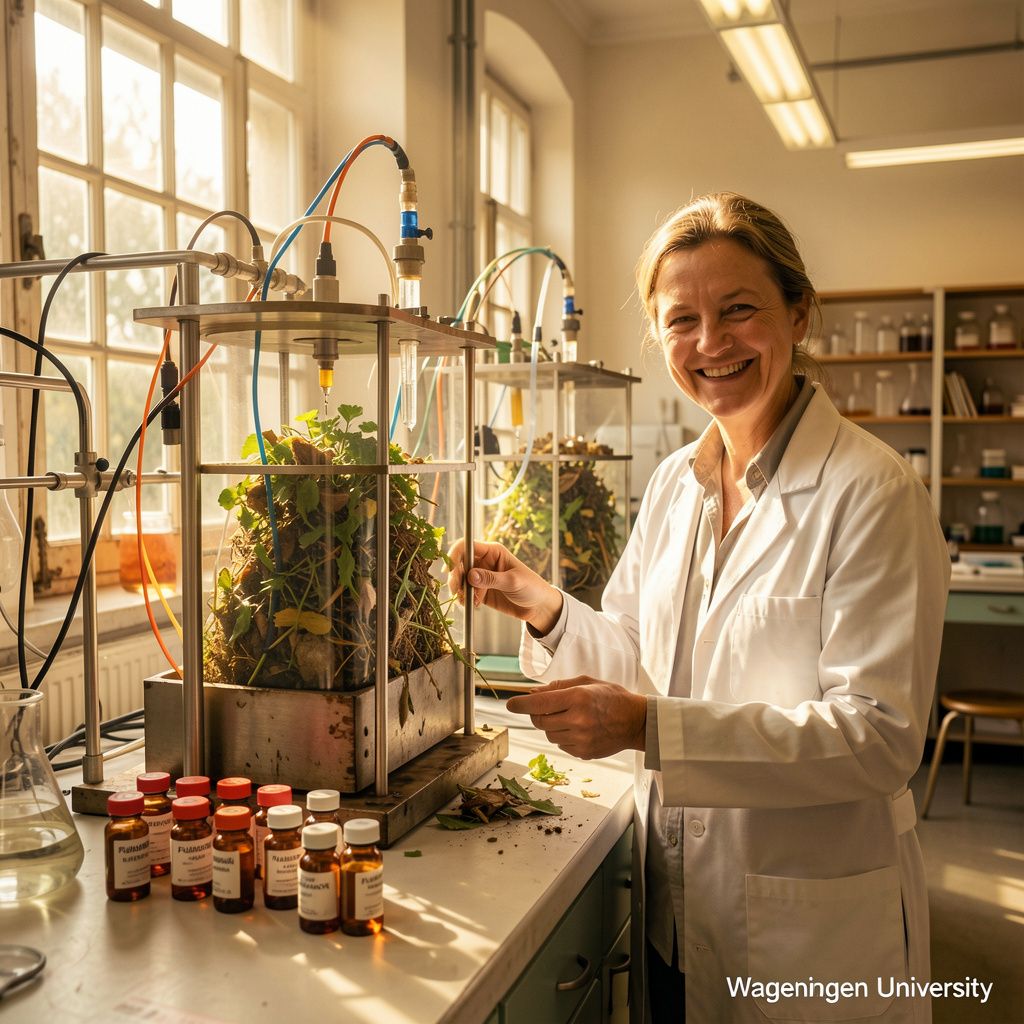
Wageningen University researchers have created a revolutionary method that transforms plant waste into furanone, a crucial building block for pharmaceuticals and plastics, using just electricity and salt. This breakthrough eliminates the need for dangerous bromine chemicals traditionally required in the process. The electrochemical technique converts furfural from agricultural waste into valuable compounds through an innovative reactor design that generates bromine safely on-demand. While currently producing small laboratory quantities, experts believe this combination of renewable electricity and biomass could reshape European chemical manufacturing by enabling local production with milder conditions than conventional methods.
Breaking Down the Chemical Innovation
The breakthrough centers on producing 2(5H)-furanone, a versatile chemical building block that serves as the foundation for manufacturing plastics, medicines, and fragrance compounds [1][2]. The Wageningen researchers, working in collaboration with Utrecht University, developed their method to convert furfural—a liquid extracted from sugars found in plant waste such as agricultural residues—into this valuable furanone [1][2]. This approach represents a significant departure from traditional chemical synthesis methods that rely on hazardous materials.
Eliminating Dangerous Chemicals Through Smart Design
The key innovation lies in the electrochemical reactor design that uses bromide salts like sodium bromide instead of liquid bromine, effectively eliminating the need to store or handle hazardous chemicals [1][2]. When electricity runs through the reactor, the bromide salt oxidizes to bromine, which then reacts with water and oxidizes furfural to produce the desired 2(5H)-furanone [1]. As Professor Harry Bitter, who holds the chair in Biobased Chemistry and Technology at Wageningen University, explained: “Het broom vormt zich alleen op het moment dat je het nodig hebt” (The bromine forms only at the moment you need it) [1]. This on-demand generation of bromine represents a crucial safety advancement in chemical manufacturing processes.
Technical Advantages and Current Production Scale
The researchers opted for an undivided cell electrochemical reactor setup, which proves both cheaper and more energy-efficient compared to separated cell alternatives [1][2]. Professor Bitter noted that traditional membrane-separated systems can be viewed “als een fijnmazige zeef waar ionen daardoorheen geperst moeten worden en dat kost extra stroom” (like a fine mesh sieve where ions must be pressed through, which costs extra electricity) [1]. To optimize the reaction and limit unwanted byproducts, the research team added small amounts of sulfuric acid to the reaction mixture [1]. In their laboratory experiments conducted as of March 31, 2026, researchers have successfully produced 0.3 milliliters of furanone [1][2], quantities sufficient for analyzing and optimizing the chemical reaction process.
Future Industrial Applications and European Impact
While the current research remains at the fundamental level, the potential for industrial scaling appears promising. Professor Bitter emphasized the developmental nature of the work: “Dit is typisch fundamenteel onderzoek. Je begint klein en probeert eerst te begrijpen hoe de chemie precies werkt. Daarna kun je gaan nadenken over toepassingen op grotere schaal” (This is typical fundamental research. You start small and first try to understand exactly how the chemistry works. Then you can think about applications on a larger scale) [1]. Daan van Es, an expert on applied, sustainable and circular chemistry, highlighted the broader significance: “Dit is een mooie combinatie van het gebruik van hernieuwbare elektriciteit met hernieuwbare grondstoffen om bouwstenen te maken voor circulaire producten” (This is a beautiful combination of using renewable electricity with renewable raw materials to make building blocks for circular products) [1]. Van Es noted that while “Er is nog een weg te gaan voordat we dit industrieel kunnen toepassen” (There is still a way to go before we can apply this industrially), the method “heeft veel potentie” (has much potential) [1]. The research findings were published in the scientific journal ChemSusChem [1], marking April 2026 as a significant milestone for sustainable chemical manufacturing in Europe.