

Why the Artificial Intelligence Boom Is Keeping America's Coal Plants Alive
Washington, Saturday, 24 October 2026.
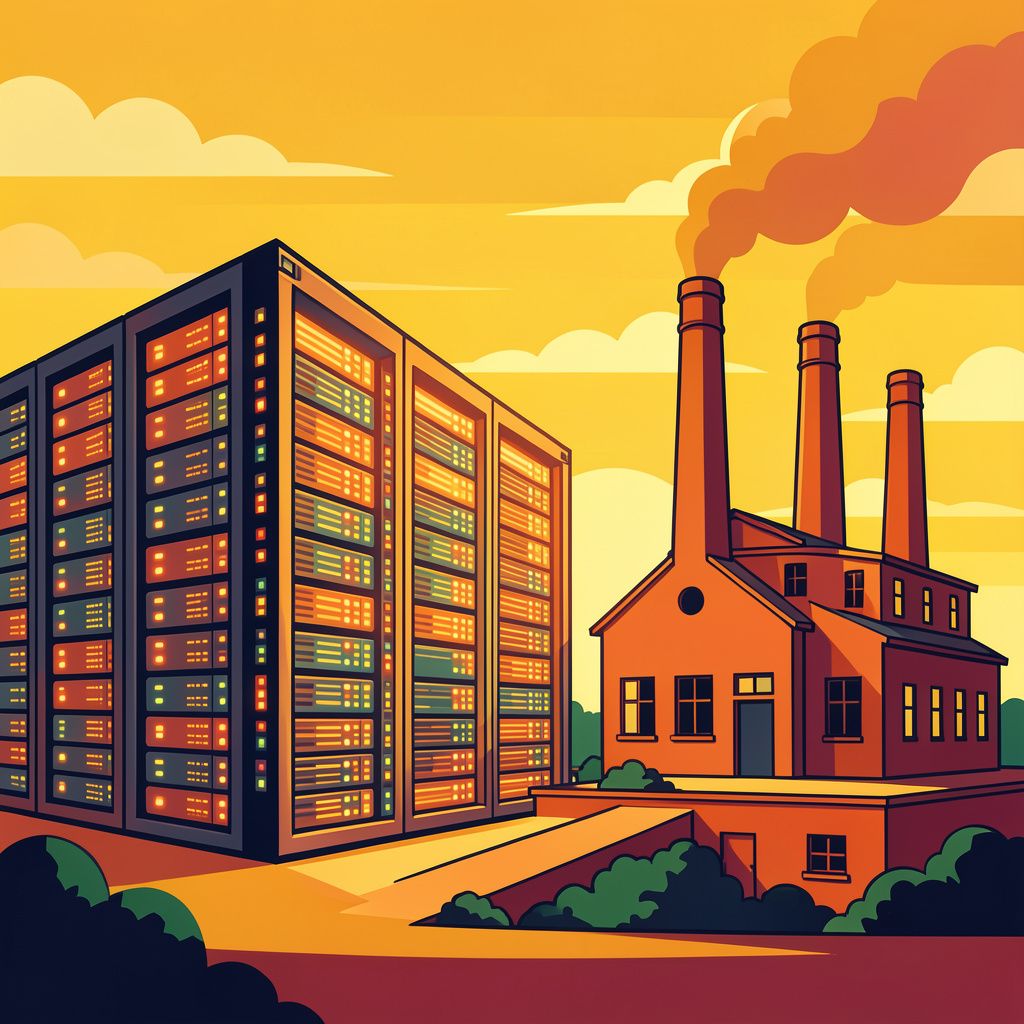
Surging artificial intelligence electricity demand has pushed U.S. coal retirements to multi-year lows, forcing tech firms to compromise climate goals to guarantee round-the-clock power for massive data centers.
Grid Realities Clash With Corporate Decarbonization
The accelerating deployment of generative artificial intelligence has fundamentally altered electricity demand curves across the United States, prompting utilities to shelve planned retirements of legacy fossil fuel generation [1]. As of October 2026, U.S. coal plant shutdowns have plummeted to multi-year lows, with operating horizons extended for facilities in Georgia, Utah, and Kansas specifically to supply high-density computing campuses [1]. Hyperscale data centers require continuous, non-stop baseload electricity 24 hours a day, 365 days a year—an operational profile starkly different from conventional residential and commercial loads that experience diurnal peaks and troughs [1]. Because utility interconnection queues and regional transmission buildouts routinely encounter regulatory and permitting delays spanning up to a decade, electric utilities are keeping depreciated coal units running and fast-tracking natural gas combustion turbines to guarantee uptime [1].
The Widening Chasm Between Paper Credits and Physical Electrons
This operational pivot has exposed critical structural limitations in corporate sustainability frameworks [1]. Historically, major technology enterprises balanced their carbon accounts by procuring Renewable Energy Certificates (RECs) and executing Virtual Power Purchase Agreements (VPPAs) [1]. While these financial mechanisms allow companies to match aggregate annual megawatt-hours on paper, physical facilities continue to draw power directly from carbon-intensive regional grids [1]. In regions facing acute net congestion—a dynamic already familiar to European hubs such as Amsterdam—drawing uninterrupted power from constrained infrastructure threatens broader grid stability [GPT]. Research from the Electric Power Research Institute and McKinsey indicates that data centers could consume between 9% and 12%, and up to 17% under high-growth projections, of total U.S. power generation by 2030 [1]. With global data center consumption having reached 415 terawatt-hours in 2024—roughly 1.5% of worldwide electricity use—the United Nations Environment Programme projects this demand could double by 2030 [4].
Economic Stakes and Escalating Local Friction
The immense energy appetite of digital infrastructure is backed by historic capital commitments, with hyperscalers Amazon, Google, Meta, and Microsoft projecting combined annual capital expenditures exceeding $600 billion in 2026, supported by collective net income surpassing $300 billion in their most recent fiscal year [2]. A policy brief by Josh Zoffer and Ben Sampson at the Stanford Institute for Economic Policy Research (SIEPR) calculates that U.S. data center capital expenditures will reach approximately $581 billion in 2026 alone, representing nearly 2% of U.S. Gross Domestic Product [3]. Across the wider horizon through 2030, McKinsey estimates cumulative global data center capital investments will hit $7 trillion, with 40%—or 2800 billion ($2.8 trillion)—slated for the United States [3]. At current deployment rates, this buildout sustains approximately 304,000 domestic manufacturing supply-chain jobs [3]. However, if domestic components outside of graphic processing units (GPUs) achieve at least 50% onshore sourcing, modeled employment could expand to 373,000 jobs, a net difference of 69000 manufacturing positions [3].
Mounting Pushback and Ratepayer Protection
Despite powerful industrial tailwinds, public opposition has intensified markedly heading into late October 2026 [2][6]. An ABC News/Washington Post/Ipsos survey released on October 23, 2026, revealed that 66% of Americans oppose constructing new data centers nationally, with local community opposition climbing to 72% [6]. Opposition is heavily compounded by anxieties over utility bills, with half of citizens viewing facilities as detrimental to household energy costs [5]. In response, technology conglomerates have begun restructuring host-community arrangements [2]. Earlier in October 2026, Amazon rolled out its ‘Amazon Data Center Commitment’ to disclose water and power consumption and upgrade backup diesel generation, while Meta and Amazon each committed $1 billion in community funds, paralleled by Google’s pledge to inject $1 billion into local programs by the end of 2027 [2]. Simultaneously, federal frameworks like the Ratepayer Protection Pledge established on March 15, 2026, mandate that technology firms fund new power generation, pay for delivery upgrades, and establish separate tariffs to protect residential customers [7].
Architectural Innovation: Modular Edge Computing
To circumvent both coal-dependent utility bottlenecks and local community backlash, digital infrastructure developers are deploying technical innovations centered on decentralized architectures and flexible grid interfaces [4]. Rather than constructing traditional monolithic hyperscale footprints, infrastructure provider Duos Edge AI, led by founder Doug Recker, has pioneered the operational deployment of modular edge data centers [4]. Deployed in Abilene, Texas, through public-private partnerships involving regional education service centers and local school districts, this modular computing model decentralizes compute capacity into smaller, containerized units [4]. As Recker highlighted, ‘data center’ describes the computational function rather than a fixed architectural format, enabling operators to distribute workloads adjacent to existing local institutional power drops rather than requiring massive multi-hundred-megawatt grid interconnects [4].
Mechanics of Flexible Interconnection and Edge Efficiency
The operational innovation behind modular edge deployments works by co-locating prefabricated, self-contained computing modules directly within distributed power networks, often pairing computing hardware with behind-the-meter generation, microgrids, or battery storage [4]. This approach aligns with broader systems efficiency guidelines published by the U.S. Department of Energy, which treat cooling, computing gear, electrical distribution, and waste heat recovery as an integrated optimization problem [4]. Complementing modular form factors, companies like Camus Energy, headed by Chief Executive Officer and co-founder Astrid Atkinson, have developed flexible interconnection models [4]. In analytical work evaluating a hypothetical 500-megawatt data center alongside Encoord and Princeton University’s ZERO Lab, Camus demonstrated how computational demand can dynamically modulate based on real-time grid conditions, effectively using software scheduling to run workloads when excess renewable capacity exists and curtailing load during local peak stress [4].
Utility Collaboration and Clean Generation Bundling
Alongside edge systems, developers are establishing contractual innovations that bind large facilities directly to clean utility builds [5]. In Pine Island, Minnesota, Google is pursuing regulatory approval for a proposed 780-megawatt AI data center in an agreement with Xcel Energy [5]. Under this structure, Google finances the addition of 1,400 megawatts of wind, 200 megawatts of solar, and 300 megawatts of grid battery storage to Xcel’s network to advance its 24/7 carbon-free energy mandate [5]. Crucially, the contract features ratepayer shield covenants requiring Google to pay for at least 75% of its contracted capacity and cover up to eight years of minimum demand charges in the event of early termination, preventing residual asset liabilities from falling onto local households [5].
Strategic Implications for Global Net Congestion
The extension of American coal assets in late 2026 serves as an urgent case study for industrial hubs worldwide grappling with severe grid congestion [1][4]. Relying on legacy fossil generation offers a temporary palliative for uptime, but it directly conflicts with long-term climate targets and stokes acute sociopolitical resistance [1][2][6]. The successful convergence of modular edge infrastructure demonstrated by Duos Edge AI in Abilene, Texas, dynamic load flexing models, and guaranteed utility capital agreements highlights the indispensable path forward [4][5]. For engineers and energy planners worldwide, harmonizing exponential AI growth with sustainable networks will require moving past passive carbon offsets toward active, flexible, and distributed computing architectures capable of operating in symbiosis with modern electrical grids [1][4].
Bronnen
- www.dailykos.com
- apnews.com
- siepr.stanford.edu
- www.forbes.com
- www.cnbc.com
- abcnews.com
- www.energy.gov