

Scientists Propose Urgent New Plan to Save the World's Underground Water
Wageningen, Thursday, 8 October 2026.
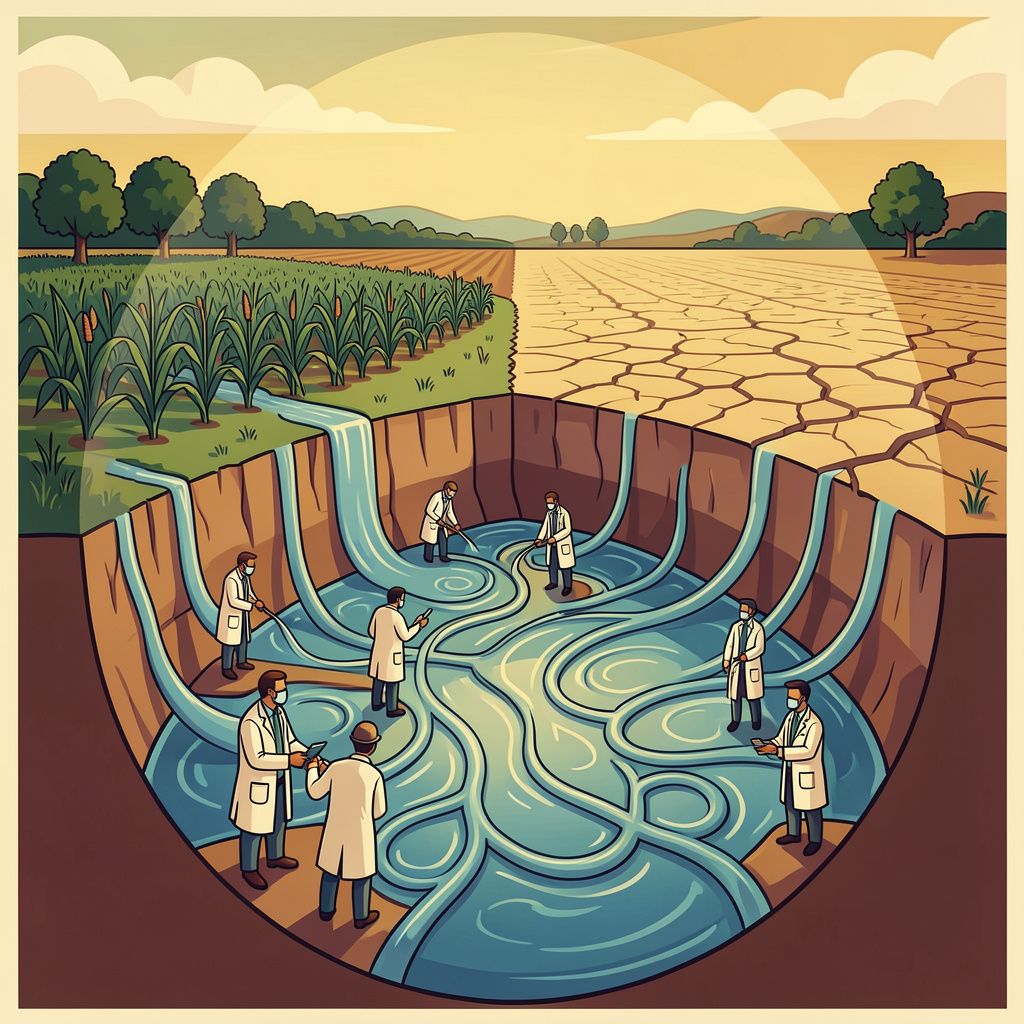
With ninety-nine percent of Earth’s freshwater stored underground, researchers warn that over-extraction risks “water bankruptcy” unless agriculture and nature policies are urgently integrated.
A Global Lifeline Under Unprecedented Pressure
Grounded in research published in Nature Water, a joint scientific coalition comprising Wageningen University & Research (WUR) based in Wageningen, Netherlands, the International Rice Research Institute (IRRI), and Cornell University has issued a stark warning regarding the world’s underground water reserves [1][3][4]. Groundwater represents nearly 99% of all available freshwater on Earth, sustaining global agricultural production, supporting fragile ecosystems, and supplying drinking water to more than one-third of the global population [1][3][5]. However, in numerous agricultural regions, extraction rates are severely outpacing natural replenishment, driven primarily by the demands of feeding a growing global population [1][3].
The Threat of ‘Water Bankruptcy’
This unsustainable depletion has led scientists to warn of severe systemic consequences. Dr. Inge de Graaf, an associate professor of Earth Systems and Global Change at WUR in Wageningen, explains that structurally extracting more groundwater than nature can replenish is equivalent to draining a finite reserve [1][3]. According to De Graaf, this trajectory could ultimately result in what many experts describe as a “water bankruptcy” [1][3]. Dr. Anton Urfels, a senior researcher in Water Management at IRRI, echoes this concern, emphasizing that while groundwater remains invisible to the naked eye, it must not remain invisible in political and economic decision-making [1][3].
Redefining the Boundaries of Water Management
To avert this looming crisis, the research team outlines three critical priorities for scientists and policymakers. First, they advocate for the establishment of dynamic limits on groundwater use that adapt to environmental changes [1][3]. Second, they highlight the necessity of mapping system-wide trade-offs between food security, nature conservation, and water availability [1][3]. Finally, they call for the development of scalable adaptation strategies [1][3]. The IRRI emphasizes that only by adopting a systems approach—wherein food supply, climate, and nature are evaluated holistically—can society secure water resources for future generations [1][3].
Translating Global Models to Regional Action
Bridging the gap between high-level science and practical application is central to the researchers’ proposal. They recommend linking global model studies with regional case studies and active stakeholder participation to foster stronger collaboration between groundwater scientists, agricultural researchers, and water managers [1][3]. At WUR, the Earth Systems and Global Change group utilizes the VIC-WUR (Variable Infiltration Capacity) model to analyze groundwater sustainability and evaluate potential water management strategies [3]. This research is highly relevant to the Netherlands, where water management policy is undergoing a fundamental shift toward making “water and soil guiding” (water en bodem sturend) in peat, sand, and coastal regions [3].
From Vision to Reality: The Dutch NL2120 Initiative
The urgency of this transition was a focal point at the “Oogstdag” (Harvest Day) event held in Wageningen on October 6, 2026 [2]. Hundreds of professionals from the water, spatial planning, and nature sectors gathered to discuss climate resilience, drought mitigation, and biodiversity loss [2]. A central theme of the event was the presentation of the “NL2120” future scenarios, which envision how the Netherlands could look in the year 2120 if natural systems are allowed to lead spatial planning [2]. Jeroen Haan, chairman of the Association of Dutch Water Authorities (Unie van Waterschappen), stressed that addressing these challenges requires long-term perspectives and cross-organizational collaboration, urging decision-makers to “listen to what the climate and nature are saying” [2].