

Swedish Startup Partners with Dutch Manufacturer to Build Revolutionary AI Chip Equipment in Europe
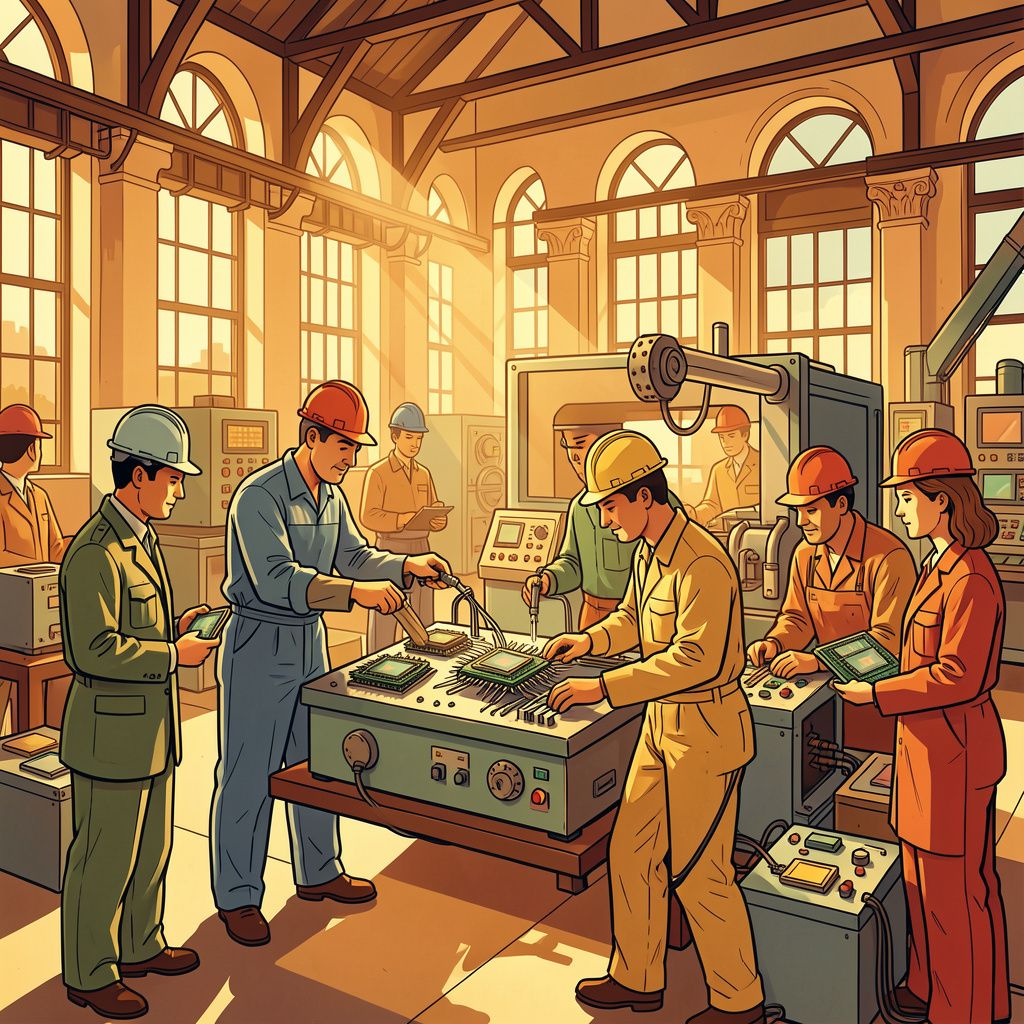
Eindhoven, Thursday, 9 April 2026.
AlixLabs’ breakthrough technology stems from an accidental lab discovery that could replace five complex manufacturing steps with one.
From Lab Accident to Industrial Revolution
This partnership represents a significant development in the semiconductor industry, focusing specifically on advanced chip manufacturing equipment rather than photonics or quantum computing [GPT]. The collaboration between AlixLabs and VDL ETG Projects centers on industrializing a revolutionary chip-patterning technology that emerged from an unexpected laboratory mishap in 2015 [1]. Jonas Sundqvist, founder and CEO of AlixLabs, was conducting experiments at Lund University’s Nano Lab when a failed attempt to shrink microscopic wires unexpectedly produced two thinner, split wires instead [1]. Sundqvist, who brought experience from chipmakers Infineon and Qimonda, immediately recognized the potential of this accidental discovery [1]. The breakthrough promised to replace up to five complex manufacturing steps with just one, offering substantial cost and energy savings in semiconductor production [1].
APS Technology: A Cost-Efficient Manufacturing Solution
AlixLabs’ APS™ (Atomic Pitch Splitting) technology addresses critical challenges in next-generation semiconductor fabrication by enabling precise pitch splitting through atomic layer etching [1]. This approach serves as a cost-efficient and energy-conscious alternative to increasingly complex multi-patterning and extreme ultraviolet-based lithography processes [1]. The technology leverages ALE (Atomic Layer Etching), a plasma-based dry etching cyclic methodology that promises to streamline manufacturing processes [2]. According to Sorin Stan, Senior Director for Emerging Technologies at VDL ETG Projects, the implementation of AlixLabs’ research in manufacturing processes for advanced semiconductor devices will contribute to overall cost reductions and increased production speeds [2][3].
Strategic Partnership Anchored in Dutch Expertise
The decision to partner with VDL ETG Projects reflects a strategic recognition of the Netherlands’ specialized manufacturing capabilities. As Sundqvist explained, “In Sweden we build fighter jets and Volvos, but not chip machines. The secret sauce for chip machines is in the Netherlands. If you want to work with the best in Europe, you need to be in the Eindhoven region” [1]. VDL ETG Projects, part of the VDL Groep industrial conglomerate founded in 1953, consists of over 100 companies with more than 14,000 employees across 20 countries [2]. The company specializes as a tier-one design and contract manufacturing partner in developing, producing, assembling, and installing production equipment, OEM machines, and mechatronic systems [3]. VDL ETG Projects, headquartered in Eindhoven, North Brabant, employs between 51-200 people and focuses on transitioning technologies from feasibility to design, engineering, and equipment realization [2][3].
Financial Backing and Market Implications
The partnership enjoys robust financial support from both Dutch and international investors. Amsterdam-based venture capital firm ForwardOne serves as a key investor, while Arthur van der Poel, former CEO of Philips’ chip division and ex-chairman of ASML’s supervisory board, sits on AlixLabs’ advisory board [1]. The startup raised €15 million in late 2025, including investment from Japan’s Canon, which is expected to facilitate market entry in Japan [1][6]. According to Arjan Göbel of investor FORWARD.one, “Canon will help introduce AlixLabs’ machines to the Japanese market” [6]. The technology’s potential impact on Europe’s chip supply chain is substantial, as existing nanometer fabrication facilities, such as GlobalFoundries in Dresden or the new TSMC plant in Germany, could potentially be upgraded using AlixLabs’ machines to produce AI chips without requiring the €20 billion investment needed to build new advanced fabrication facilities from scratch [1]. AlixLabs is currently in discussions with three major potential customers in Asia and aims to have its first machines installed in fabrication facilities for testing by early 2027, with full mass production targeted for 2029 [1].
Bronnen
- ioplus.nl
- www.alixlabs.com
- nl.linkedin.com
- fd.nl
- linkmagazine.nl
- nl.linkedin.com
- nl.linkedin.com
- linkmagazine.nl