

The Netherlands Allocates Millions to Expand Fast Cycling Routes
Utrecht, Thursday, 12 November 2026.
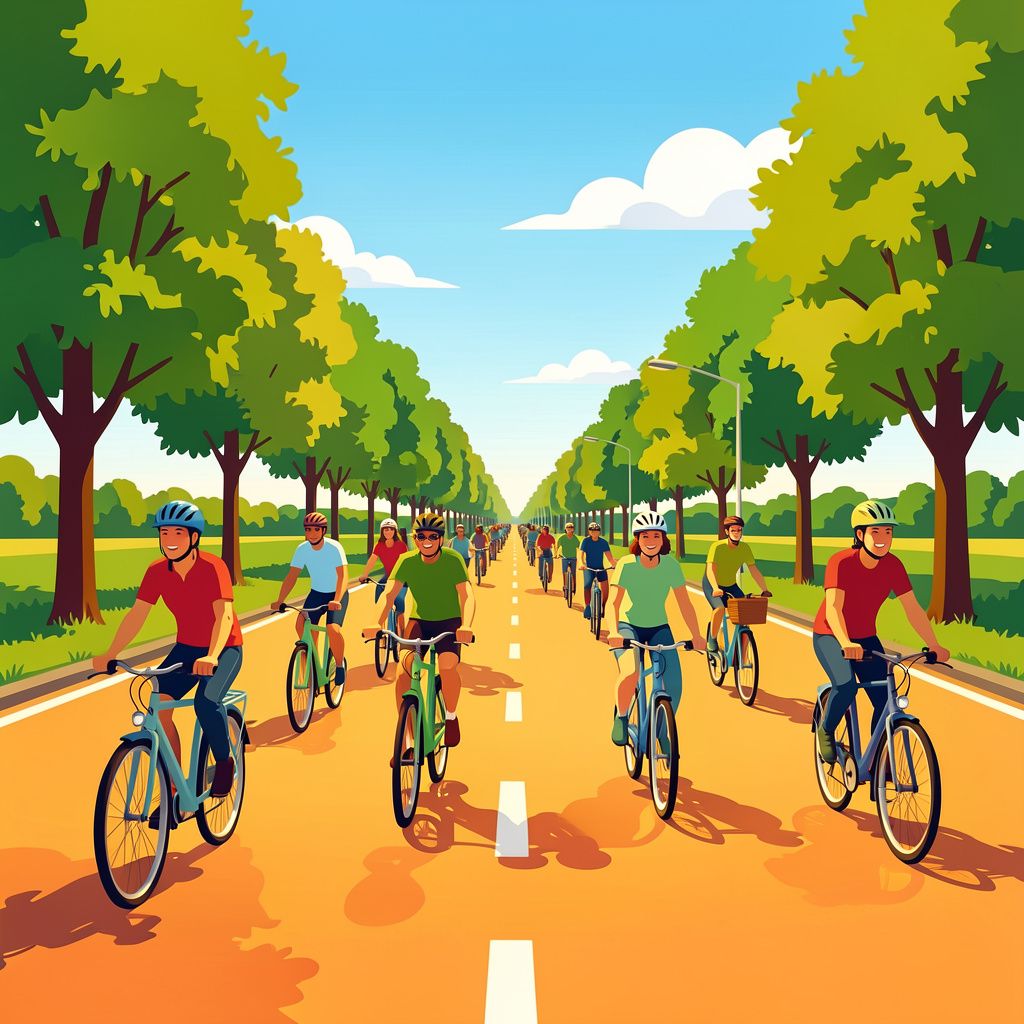
The Dutch government is committing €24 million across 19 fast cycling routes, advancing an ambitious strategy to double the nation’s 1,000-kilometer regional cycling network by 2030.
Strategic Co-Funding for Key Intercity Corridors
The Dutch Ministry of Infrastructure and Water Management, based in The Hague, announced on Wednesday, November 11, 2026, an allocation of approximately €24 million to co-finance 19 high-speed cycle routes across the Netherlands [1][2][3][4]. The national package distributes targeted capital to regional authorities responsible for engineering, widening, and extending these green transit corridors [1][3][4]. Among the standout allocations, the Province of Noord-Brabant secured the single largest allocation of more than €2,700,000 to construct a fast link between Eindhoven and Gemert, an initiative executed jointly by the province alongside the municipal governments of Eindhoven, Nuenen, Laarbeek, and Gemert-Bakel [1][8]. Furthermore, Zuid-Holland received nearly €2,200,000 for a designated express path between Alphen aan den Rijn and Gouda, while Overijssel was awarded €1,700,000 to advance a cycling link between Enschede and Glanerbrug [1][3][4].
Unlocking Long-Haul Commuter Transit Along the A2
A central priority within the national investment plan is the ‘Dom to Dam’ route connecting Utrecht’s historic Dom Tower directly to Amsterdam’s Dam Square, supported by a central government contribution of €1,800,000 [1][3][4]. The approximately 40-kilometer corridor has remained on institutional agendas since early conceptual designs emerged in 1990 [1]. In September 2026, regional authorities signed an agreement to advance the project, setting construction to begin in 2028 [1]. The state’s €1,800,000 pledge covers a fraction of the venture’s broader capital requirement, as earlier project reporting estimates the overall development cost at roughly €57 million [1], leaving the national share at 3.158 percent of total projected expenditure.
Overcoming Civil Engineering and Congestion Bottlenecks
The Utrecht-Amsterdam track is designed to largely trace the Amsterdam-Rhine Canal and parallel the congested A2 motorway, requiring path expansions, dedicated rights-of-way, upgraded lighting, modern signage, and safer junction design [1]. A major engineering obstacle centers on the Demka Bridge spanning the Amsterdam-Rhine Canal, where authorities note an entirely new bridge structure could ultimately be needed to complete an uninterrupted transit route [1]. In parallel, commuter links across the Randstad are being addressed, with the Rotterdam and The Hague region securing €1,200,000 for a route between Ridderkerk and Rotterdam and €1,000,000 for a link connecting Delft and Rotterdam Alexander [1][3][4].
Integrating Active Transport Into Long-Term Urban Growth
Fast cycling routes, or ‘doorfietsroutes’, are designed to optimize travel speeds by giving cyclists continuous right-of-way and minimizing stops, establishing cycling as a viable green alternative to automobile travel for longer-distance daily commutes [8]. Across the Netherlands, existing infrastructure encompasses more than 1,000 kilometers of high-speed paths, and the cabinet’s strategic framework targets doubling that footprint by 2030 [1][2][8]. As State Secretary Annet Bertram and Minister Vincent Karremans outlined during bilateral talks in November 2026, the central government is prioritizing active travel routes alongside maintenance across bridges, rail bottlenecks, and waterways to ensure sustainable regional economic connectivity from Maastricht to Heerenveen [2].
Bronnen
- nltimes.nl
- www.rijksoverheid.nl
- www.noordhollandsdagblad.nl
- nieuws.nl
- hollandrijnland.nl
- fietsdossier.nl
- ambtenaar.online
- www.omroepbrabant.nl