

Living Algae Replace Motors in New Soft Robotic Devices
San Francisco, Monday, 9 November 2026.
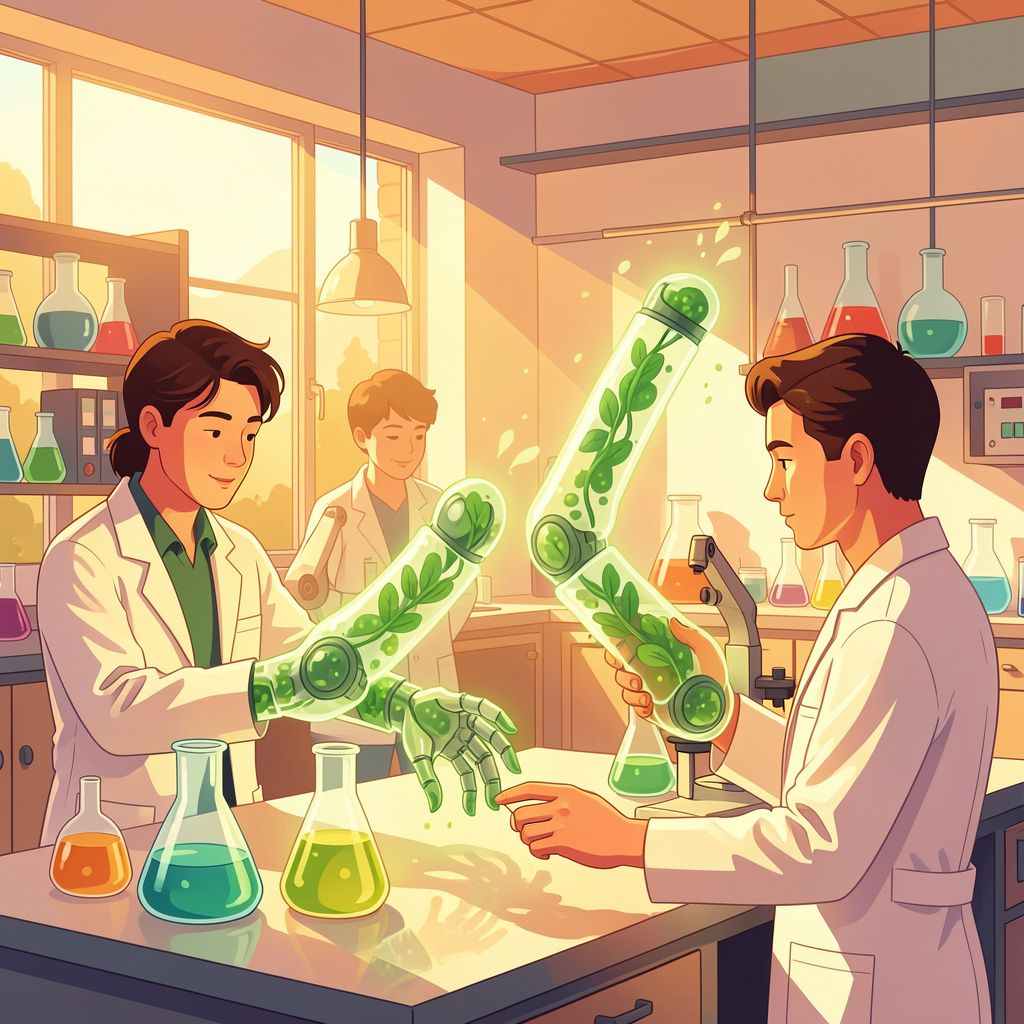
Delft researchers unveiled soft robotic arms that move using photosynthetic algae, creating natural motion purely through light-driven chemical changes without batteries, motors, or external fuel lines.
Biotechnology Architecture and Photosynthetic Actuation
This bioengineering milestone represents a distinct advancement in agritech and healthtech automation [GPT], demonstrating how living microalgae can actuate mechanical systems without complex electromechanical motors, wiring, or chemical fuel supplies [1][2]. Developed by researchers at the Delft University of Technology (TU Delft) in the Netherlands [1][4], the project was led by Professor Marie-Eve Aubin-Tam alongside PhD candidate and first author Fan Jiang [6]. The scientific findings, published in late October 2026 in Nature Communications under the title ‘Light-powered photosynthetic living actuator’ [4][6], established that metabolic processes from live cellular cultures can directly deliver physical actuation in underwater soft robotics [2][4].
Biotechnology Architecture and Photosynthetic Actuation
The miniaturized robotic arm consists of a flexible green strip measuring approximately 2 cm (0.02 m) in length and 1 mm (0.001 m) in thickness—roughly three-quarters of an inch long and as thick as a credit card [1][2]. The actuator’s architecture integrates two distinct hydrogel layers with living photosynthetic microalgae colonized across the surface [1][2]. The device operates entirely without genetically modified algae [1]. Instead, it capitalizes on the organisms’ natural metabolic cycles: when exposed to light, the algae undergo photosynthesis, taking up carbon dioxide (CO2) and nitrogen while synthesizing sugars [1][2][4]. This uptake reduces local acidity and increases the pH level within the surrounding hydrogel matrix [1][2].
Chemical Dynamics and Reversible Hydrogel Swelling
Mechanical movement is achieved through differential expansion between the two hydrogel strata [2][6]. As pH changes occur, the two layers swell to different degrees, forcing the strip to curl and bend into an operational grip [2][6]. In acidic environments between pH 3 and pH 7, the responsive hydrogel layer contracts to approximately 37 percent of its original baseline weight [1]. Under alkaline conditions reaching pH 11, the responsive layer swells dramatically to quadruple its baseline, representing a weight increase factor of 10.811 relative to its contracted acidic state [1]. Although full, substantial bending requires several hours, primary chemical shifts register within approximately 20 seconds of illumination [1].
Chemical Dynamics and Reversible Hydrogel Swelling
The mechanical process reverses seamlessly when the light source is extinguished [1][2]. Deprived of illumination, the algal cells shift from photosynthesis to cellular respiration, consuming stored cellular fuels and expelling carbon dioxide into the hydrogel [1][2]. This metabolic byproduct lowers the local pH, causing the responsive layer to shrink back toward its contracted form [1][2]. Remarkably, the actuator initiates reverse bending within just 10 seconds after darkness falls [1][2][4]. Because plantlike microalgae are largely self-sustaining and rely exclusively on light, ambient water, and ambient nutrients, they provide a much hardier alternative than animal-derived cell cultures that depend on fragile biological broths [2][6].
Experimental Validation Across Agritech and Healthtech
To demonstrate practical utility, the Delft research team constructed multiple physical designs, including a hook-shaped arm and a four-fingered gripper [1]. In laboratory trials, these microalgae-actuated mechanisms successfully hooked, grasped, and lifted lightweight test articles underwater, such as a hollow metal sphere and a small rubber ring [1][2][4]. While commercialization will demand improvements to the multi-hour operational cycle [1], the elimination of external power lines, batteries, and rigid metal assemblies introduces major benefits for sensitive marine agritech ecosystems, delicate underwater crop management, and non-invasive healthtech monitoring systems [1][4][6].
Bronnen
- www.wired.com
- www.biotechniques.com
- www.facebook.com
- www.innovativematerials.nl
- www.youtube.com
- scientificinquirer.com
- www.linkedin.com
- www.instagram.com