

Scientists Use Robotic Exoskeletons to Improve Musical Performance Between Violin Players
Amsterdam, Sunday, 29 March 2026.
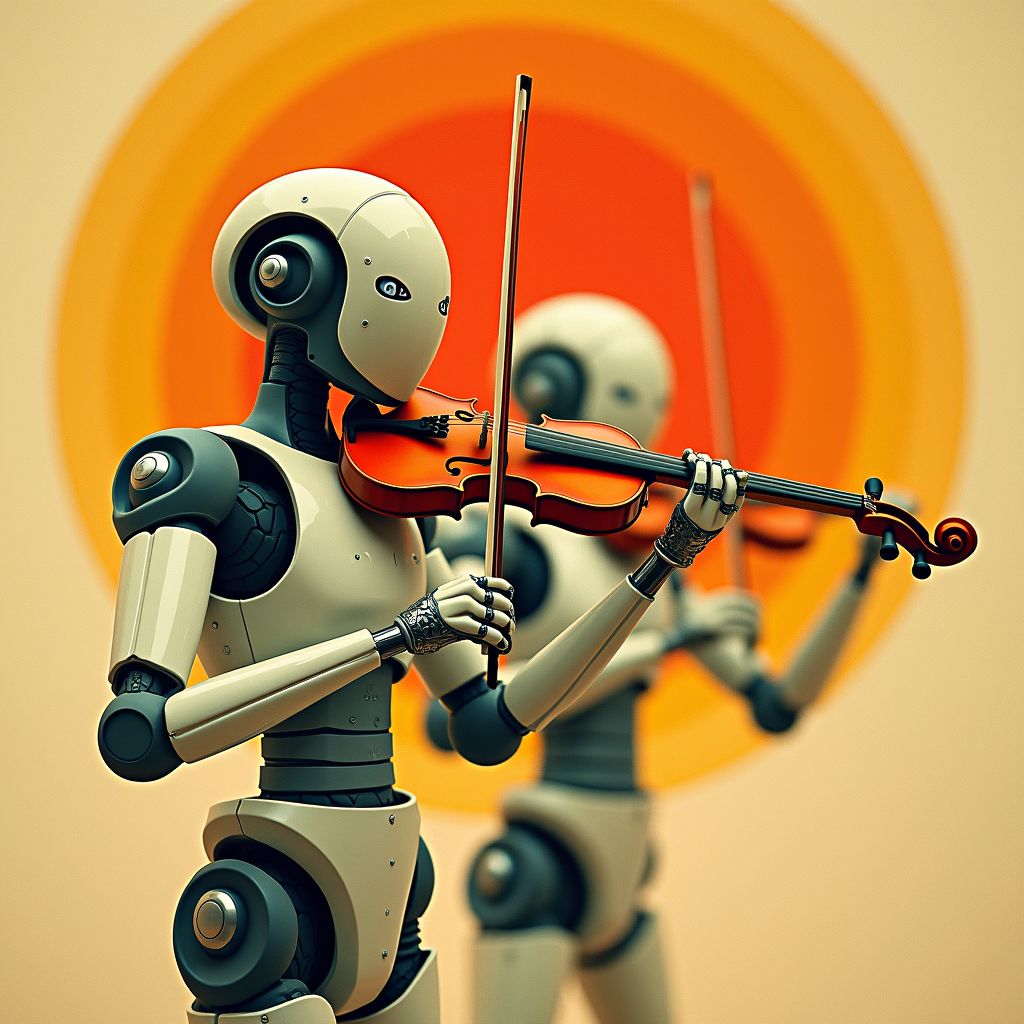
Italian researchers have successfully demonstrated that lightweight robotic exoskeletons can enhance coordination between violin duos through haptic feedback. Musicians unknowingly received subtle movement cues from their partners through the devices, improving both timing and musical alignment even when visual contact was blocked. Most participants were unaware the forces came from their playing partner, yet coordination improved significantly. The technology could revolutionize musical training and extend to rehabilitation therapy applications.
How the Revolutionary Technology Functions
The robotic exoskeletons developed by researchers at Università Campus Bio-Medico in Italy are specifically designed for upper limb assistance, targeting shoulder and elbow movements with remarkable precision [1]. Francesco Di Tommaso, a robotics researcher at the institution, explained that the devices assist “the flexion extension of the elbow and the internal and external rotation of the shoulder” [1]. The lightweight systems attach to violinists’ bow-playing arms and deliver haptic feedback that physically couples performers, transmitting subtle movement information between them [1]. During the March 2026 study published in Science Robotics, infrared cameras and sensors meticulously recorded arm angles, shoulder positions, and bow force to measure the technology’s effectiveness [1].
Comprehensive Testing Reveals Surprising Results
The research team conducted systematic testing under four distinct conditions to isolate the impact of different sensory inputs on musical coordination [1]. Professional violinists performed while hearing but not seeing each other, both hearing and seeing each other in traditional fashion, playing with vision blocked but exoskeleton feedback active, and finally with full sensory feedback combined with the robotic assistance [1]. The results demonstrated that replacing visual cues with haptic feedback actually enhanced coordination in both movement mechanics and musical alignment [2]. Di Tommaso noted that participants “were able to perform better both in terms of their movements and in terms of musical output” when haptic feedback substituted for visual contact [2].
Musicians Unaware of Technology’s Source
Perhaps the most intriguing aspect of the study emerged from post-experiment interviews with participants, who remained largely oblivious to the true nature of the forces they experienced [1]. “They were unaware of the origin of those forces and most of them did not realize that they were actually coming from their partner,” Di Tommaso revealed [1]. Some musicians even reported discomfort when perceiving the haptic forces, yet the data showed these same forces significantly improved their coordination abilities [1]. This counterintuitive finding suggests that conscious awareness may not be necessary for the technology to enhance performance, opening possibilities for more seamless integration into musical training [1].
Broader Applications Beyond Musical Performance
Professor Domenico Formica, a bioengineer involved in the research, envisions applications extending far beyond the concert hall into medical rehabilitation [1][2]. The technology could enable therapists to interact directly with patients through bilateral force exchange, potentially improving recovery outcomes during therapy sessions [2]. Formica suggested that “two patients could work together to be challenged in the process of their recovery,” creating collaborative rehabilitation environments mediated by robotic assistance [2]. This March 2026 breakthrough represents part of a growing trend in educational exoskeletons that provide physically guided experiences combining accuracy, consistency, and repetition for skill development across multiple domains [3]. The technology joins similar innovations in golf training, piano instruction, and other motor learning applications that are reshaping how humans acquire and refine complex movement patterns [3].