

Japanese Robot Achieves 81% Success Rate in Smart Tomato Harvesting
Netherlands, Sunday, 5 April 2026.
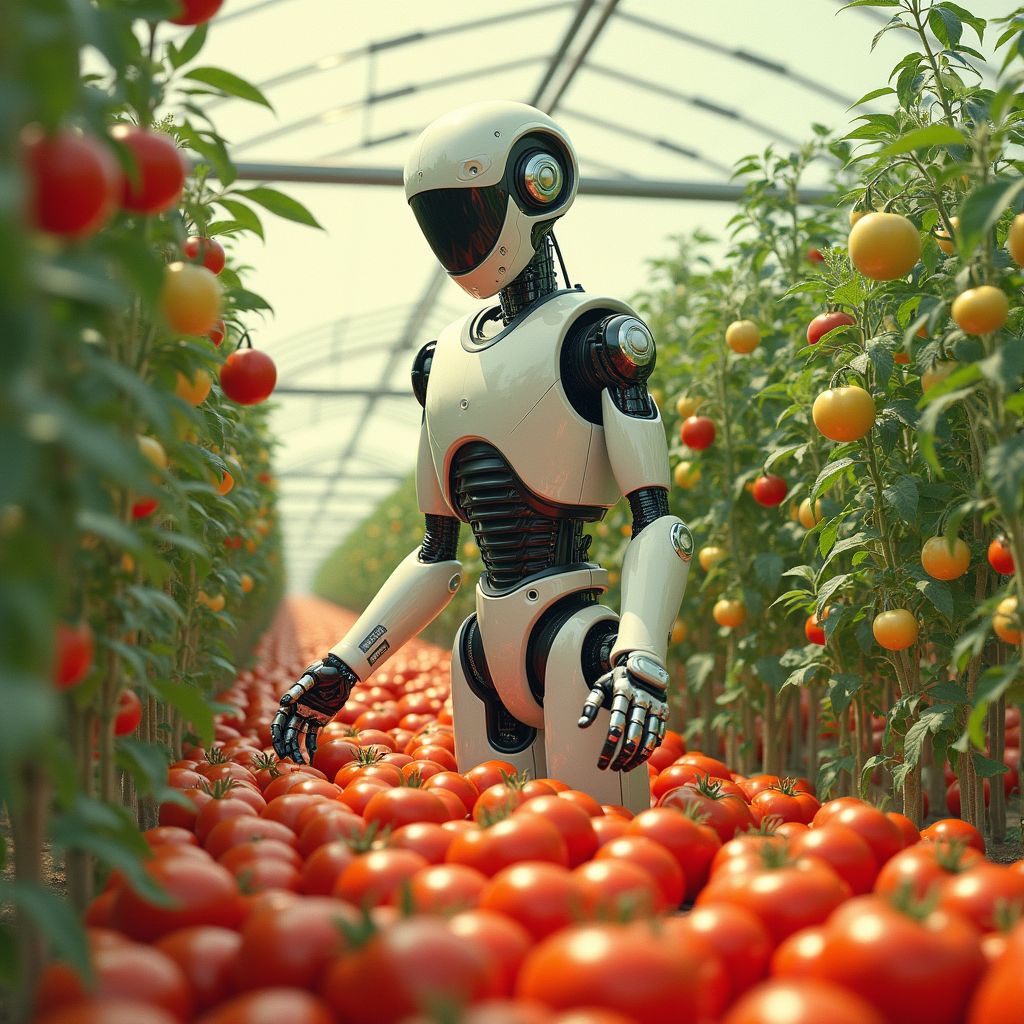
Revolutionary agricultural breakthrough shows AI-powered robot predicting harvest difficulty before picking each tomato, achieving remarkable 81% success rate. The system analyzes visual cues and adjusts angles when initial attempts fail.
Innovation Category and Technical Breakthrough
This development falls squarely within the agritech sector, representing a significant advancement in agricultural robotics [GPT]. The breakthrough addresses chronic labor shortages that have plagued European greenhouse operations, where farm labor supply has decreased by up to 30% since 2010 [1]. Assistant Professor Takuya Fujinaga of Osaka Metropolitan University’s Graduate School of Engineering developed this revolutionary system that fundamentally changes how robots approach tomato harvesting [2]. Rather than simply identifying ripe fruit, the robot employs what Fujinaga calls “harvest-ease estimation” - a predictive approach that assesses the likelihood of successful picking before attempting to harvest each tomato [2].
How the Technology Works
The system combines sophisticated image recognition with statistical analysis to determine the optimal picking angle for each fruit [2]. The robot analyzes multiple visual elements including the tomato itself, its stems, and whether it is obscured by leaves or other plant parts [2]. These inputs guide the robot in selecting the most effective approach for harvesting each individual fruit [2]. During testing, approximately 0.25 of successful picks came from tomatoes that were harvested from the side after an initial front-facing attempt failed, demonstrating the robot’s ability to adapt its strategy when the first approach proves unsuccessful [2]. This adaptive capability represents a major evolution from traditional systems that focus solely on fruit detection and identification [2].
Performance Results and Market Context
The Japanese system achieved an impressive 81% success rate during testing, exceeding initial expectations [2]. This performance stands as a benchmark in the rapidly evolving agricultural robotics market, where multiple players are pursuing similar automation goals [GPT]. Concurrent developments include German startup eternal.ag, which secured €8 million in March 2026 to develop their Harvester robot capable of operating up to 22 hours daily [3]. Meanwhile, Wageningen University & Research has been developing simulation environments since May 2024 in collaboration with DENSO and Certhon to accelerate robotic harvesting development [4]. Research teams have also achieved breakthroughs in stem detection, with the YOLO-LSBA model reaching 97.1% precision and 92.4% average precision for cherry tomato stem recognition as of March 31, 2026 [5].
Future of Human-Robot Agricultural Collaboration
Fujinaga envisions a collaborative future where robots and humans work together in agricultural settings, with robots automatically harvesting easily accessible tomatoes while humans handle more challenging fruits [2]. This approach addresses the complex variables affecting robotic harvesting, including tomato clustering patterns, stem shapes and positions, surrounding foliage, and visual obstruction [2]. The research establishes “ease of harvesting” as a quantitatively evaluable metric, bringing the agricultural industry closer to realizing intelligent robots capable of informed decision-making [2]. As farm labor shortages continue to push agriculture toward greater automation, these advances in predictive harvesting technology could transform greenhouse operations across the Netherlands and beyond, offering growers predictable and resilient operations in an increasingly uncertain labor market [1][3].