

Why Dutch River Passages Fail to Restore Vanishing Fish Populations
Wageningen, Thursday, 5 November 2026.
Despite heavy investment in modern fish passages, a 22-year study reveals fish populations still decline without ongoing debris maintenance, dynamic water flow management, and coordinated river basin planning.
The Disconnect Between Physical Infrastructure and Ecological Recovery
Public capital allocation across European waterways has increasingly targeted environmental connectivity, yet standalone civil engineering assets often fall short of their ecological objectives [1]. Doctoral research conducted by Panos Panagiotopoulos, a researcher at Wageningen University & Research in Wageningen, Netherlands, indicates that constructing fish passages alone cannot remediate fragmented aquatic habitats [1]. Analyzing performance metrics across 82 fish passages in Dutch rivers and streams, Panagiotopoulos identified that while 92.105% of the 38 native fish species detected in surrounding habitats made use of these structures, their presence did not automatically secure species-level recovery [1]. The findings arrive at a pivotal moment as regional water authorities navigate statutory obligations established under the European Water Framework Directive (Kaderrichtlijn Water) [1].
Long-Term Watershed Data Exposes Structural Limitations
A granular examination of long-term ecological dynamics highlights the limitations of treating barrier bypasses in isolation [1]. Panagiotopoulos reviewed fish passage management and operational maintenance within the administrative jurisdiction of Waterschap Brabantse Delta, alongside a comprehensive 22-year assessment of ecological trends across the Dommel river basin [1]. Despite substantive public investments dedicated to installing passages, demolishing artificial barriers, re-meandering canalized river bends, and treating municipal and agricultural run-off to enhance water quality, overall fish community recovery failed to materialize [1]. Rather than exhibiting measurable gains, standardized ecological quality scores specifically assigned to fish communities declined over the evaluation window, even as comparable biological indicators for macroinvertebrates showed marked improvements [1].
Hydrological Bottlenecks Across Multi-Barrier Corridors
Spatial complexity along migration corridors compounds these ecological deficiencies [1]. Over a dedicated five-year evaluation along the Vecht river in the province of Overijssel, Panagiotopoulos monitored the tracking profiles of three key species—sea trout, ide, and burbot—navigating a corridor obstructed by 11 consecutive weirs equipped with fish passages or bypass channels [1]. The observed migration success varied sharply by swimming capacity and route length [1]. Sea trout demonstrated multi-barrier traversal crossing the border into Germany, ide predominantly remained within Dutch borders after crossing fewer weirs, while burbot experienced minimal utility from the installed structures [1]. Panagiotopoulos emphasized that while an individual fish may traverse one weir, navigating ten subsequent structures requires unified watershed management, noting that passage efficiency is deeply linked to river discharge rates rather than mere presence [1].
Operational Maintenance and Hydro-Climatic Stresses
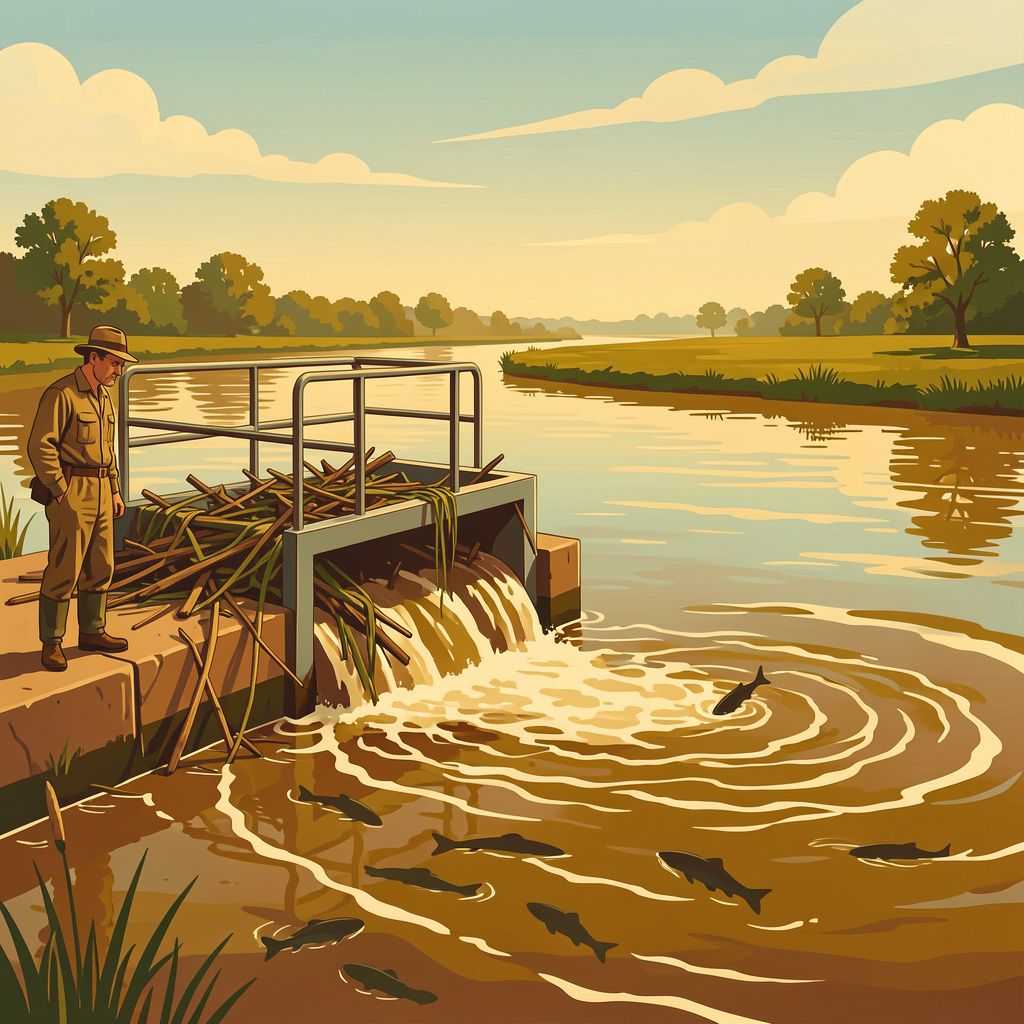
The gap between capital deployment and biodiversity dividends frequently stems from maintenance regimes and hydrological variability [1]. Passages routinely suffer from mechanical blockages caused by accumulated branches, leaves, and dense aquatic vegetation, a vulnerability exacerbated when water boards restrict asset maintenance exclusively to the spring season rather than maintaining channels year-round [1]. Concurrently, severe dry summers diminish fish densities and sharpen direct resource trade-offs between agricultural water allocations and ecological flow regimes, leaving fish dependent primarily on rare high-discharge windows to bypass barriers [1]. Consequently, Panagiotopoulos noted that structural success relies heavily on ongoing operational stewardship by water maintenance crews alongside design engineers, urging that policy benchmarks evaluate realized natural biodiversity returns rather than the gross volume of concrete bypass installations [1].
Complementary Acoustic Tracking Across Dutch Water Corridors
Parallel scientific initiatives are deploying advanced telemetry to evaluate whether aquatic species can circumvent heavy civil and maritime infrastructure elsewhere across the Dutch delta [3]. On Tuesday, October 27, 2026, Wageningen Marine Research—operating under the multi-agency ‘Monitoring vismigratie fase 2’ program alongside Rijkswaterstaat, the province of Noord-Holland, and Hoogheemraadschap Hollands Noorderkwartier—captured and tagged 13 European eels under the A8 highway at Raadhuisstraat in Koog aan de Zaan [3]. After being anesthetized and measured, the specimens were released with acoustic transmitters to track their transit across Dutch obstacles including the Zaangemaal, the Wilhelminasluis, and the IJmuiden maritime locks, with full research conclusions scheduled for release in 2027 [3]. Supported by a network of approximately 45 acoustic tracking receivers deployed across the Noordzeekanaal and Amsterdam-Rijnkanaal basin, alongside specialized fish passage trials at Nauerna and Overtoom, the study evaluates the outward journey of adult eels toward their spawning grounds located more than 6,000 kilometers away in the Sargasso Sea [3].