

How Artificial Intelligence Is Set to Protect the World's Food Supply
Wageningen, Thursday, 29 October 2026.
Backed by a $50 million investment, a global initiative uses artificial intelligence and gene editing to engineer heat-resistant staple crops, guided directly by survey feedback from tens of thousands of farmers.
Agritech Breakthrough: Scaling Climate-Resilient Staple Crops
This major development belongs firmly to the agritech sector, bridging advanced data science with molecular plant genomics to secure global agricultural resilience [1][2]. The newly launched four-year initiative, named TRITON (Traits for Resilience Initiative for Transformative Outcomes for Novel Crops), is backed by a $50 million investment—equivalent to approximately €44 million—co-funded by the Bill & Melinda Gates Foundation and the Novo Nordisk Foundation [1][6]. Running from late October 2026 through October 2030, the project directly confronts the compounding systemic risks that climate change imposes on food security [1][6][7]. By focusing squarely on foundational staple crops, the consortium aims to insulate smallholders and global supply chains from the accelerating frequency of severe droughts and temperature anomalies [1][2][6].
Institutional Leadership and Global Network Across Continents
The initiative is coordinated by Wageningen University & Research (WUR), an agricultural research powerhouse located in Wageningen, the Netherlands [1][6]. Scientific leadership is directed by Agnieszka Golicz, professor and chair of Plant Breeding at Wageningen University & Research [1][2]. Richard Harrison, director of the Plant Sciences Group in Wageningen, emphasized that the university has championed fair technology access for trusted partners since 2021 to lower entry barriers for high-impact innovation [1][7]. Alongside WUR, the research alliance spans top-tier institutions across Europe, North America, and Africa, including Utrecht University in the Netherlands, the University of Copenhagen and Aarhus University in Denmark, Justus Liebig University Giessen in Germany, the University of California, Davis, and the Innovative Genomics Institute in California, United States, as well as Kenyatta University in Kenya, accompanied by CGIAR centers and national agricultural bodies [1][2][6][7].
The Mechanism: Merging AI Predictive Modeling with CRISPR Precision
Improving complex multigenic traits like abiotic stress tolerance has historically taken decades through standard crossbreeding methods, as heat and drought defenses involve hundreds of interconnected plant genes [1][2]. TRITON overcomes this bottleneck by applying artificial intelligence and predictive computer models to parse genomic patterns and pinpoint the most promising target genes responsible for stress resistance [1][2]. Once AI models forecast how specific genes interact with dynamic environmental stressors, researchers deploy targeted CRISPR-Cas gene-editing tools to make precise modifications directly into high-performing plant breeding lines [1][2]. The operational workflow initially focuses on three critical staple crops: maize, rice, and sorghum [1][2][5]. Scientists are specifically analyzing how engineered seeds germinate under extreme stress and monitor their development during early plant growth phases [2][5].
Farmer Feedback and Open Access for Developing Markets
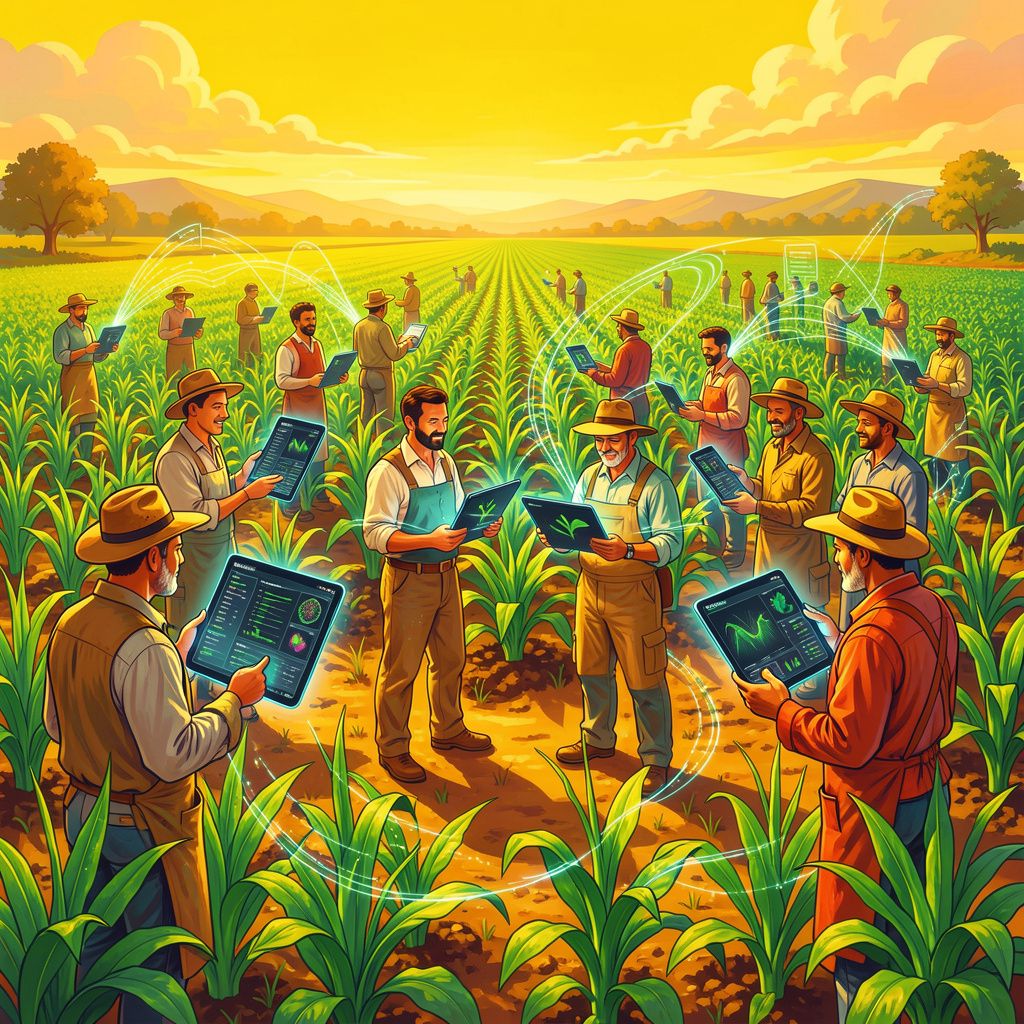
A defining operational innovation within TRITON is the integration of direct stakeholder feedback into the laboratory pipeline through a survey platform powered by large language models [1][2][7]. By aggregating and analyzing field-level data from tens of thousands of farmers and food chain participants across diverse geographies, the consortium ensures that algorithmic selections reflect real-world agronomic and post-harvest requirements [1][2][7]. The resulting resilient varieties will be evaluated in field trials held across multiple continents to validate performance under varied soil and weather conditions [1][2][7].
Democratizing Intellectual Property to Empower Smallholders
Beyond advancing core plant biology, the program establishes an open-access technological pipeline to democratize modern biotechnology [2][5]. TRITON will make its generated datasets, combinatorial computational models, and targeted DNA modification tools freely accessible across the globe [2][5][6]. This framework enables small- and medium-sized seed enterprises, non-governmental organizations, and domestic research entities in low- and middle-income nations to implement high-level gene editing without prohibitive licensing costs, driving long-term agricultural stability in regions most vulnerable to climate disruption [2][5][6].
Bronnen
- www.wur.nl
- www.nieuweoogst.nl
- www.threads.com
- x.com
- www.agriholland.nl
- www.gelderlander.nl
- www.akkerbouwbedrijf.nl
- www.facebook.com