

How Artificial Intelligence Could Soon Automate Cancer Biopsy Analysis
Eindhoven, Monday, 2 November 2026.
Securing 3.7 million euros from Europe’s competitive Pathfinder program, TU Eindhoven leads an initiative to build the first automated, smart microscope capable of analyzing cancer biopsies without human intervention.
Securing European Deep-Tech Capital for HealthTech Disruption
On Monday, 2 November 2026, the European Innovation Council (EIC) confirmed the selection of the BRIGHT project for a €3.7 million Pathfinder grant [1][2]. The competitive funding round highlights an escalating public investment push into HealthTech, a specialized convergence of healthcare diagnostics and deep-technology engineering [GPT]. Out of 2,104 global research proposals submitted to the EIC Pathfinder programme this year, only 43 projects secured financing, representing a selective acceptance rate of 2.044% [1][2]. Demonstrating robust scientific and structural feasibility, the BRIGHT initiative scored 4.89 out of 5 during rigorous panel evaluations, ranking 8th overall in the entire cohort [1][2].
Consortium Leadership and Operational Architecture
The BRIGHT project is spearheaded by Lorenzo Albertazzi, an associate professor based at Eindhoven University of Technology’s (TU/e) Department of Biomedical Engineering [1][2]. Coordination of the cross-border venture remains anchored in Eindhoven, the Netherlands, where Albertazzi and his research team have spent years refining nanoscale imaging [1][2]. The consortium combines academic powerhouses and industrial technical units across Europe, including Radboudumc, the University of Lisbon, the University of Copenhagen, Vilnius University, Sweden’s KTH Royal Institute of Technology, and deep-tech firm Ultimeyes [1][2].
Mechanics of the Autonomous Single-Molecule Platform
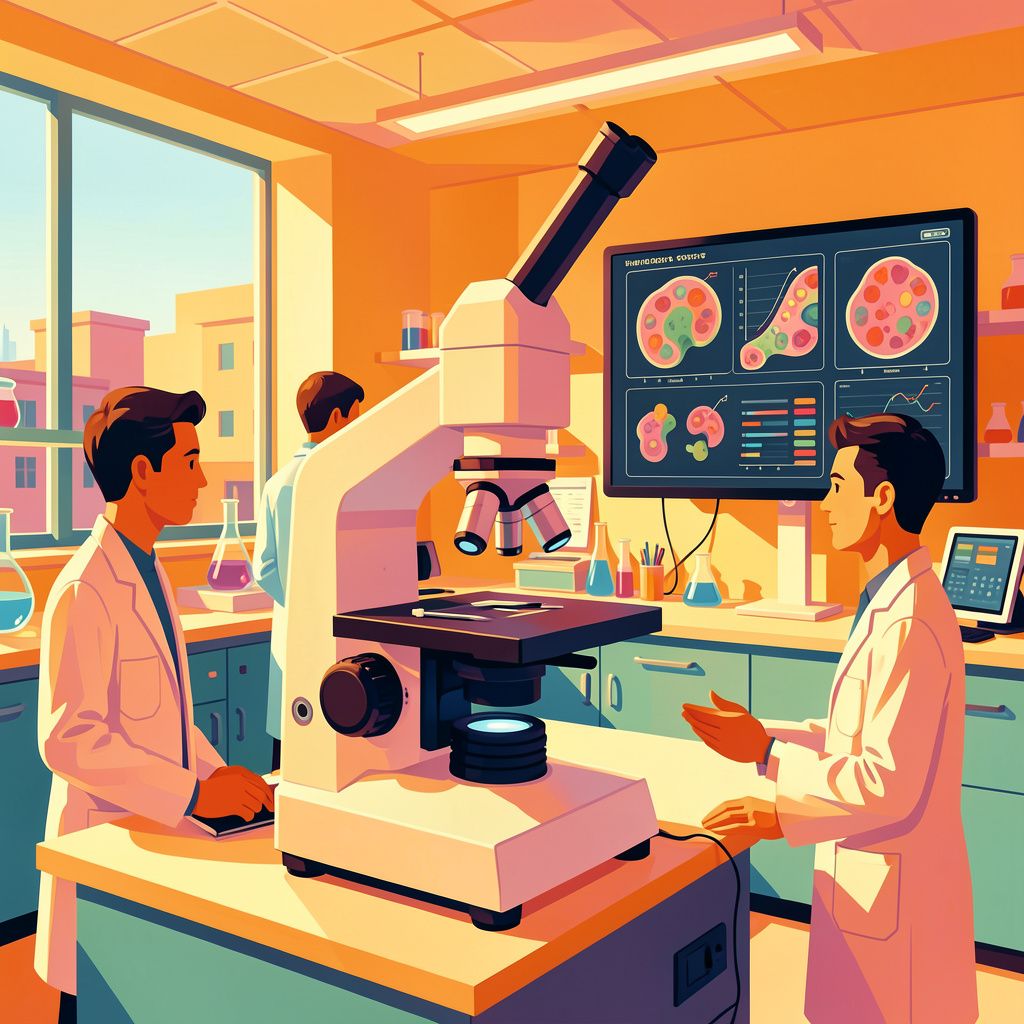
At its technical core, the platform operates by pairing super-resolution light microscopy with advanced machine learning algorithms and robotics to eliminate manual diagnostic bottlenecks [1][2]. Instead of requiring specialized technicians to manually prepare, inspect, and evaluate cell structures, the diagnostic microscope automatically interrogates tissue biopsies with single-molecule sensitivity [1][2]. Albertazzi noted that ‘BRIGHT is where light meets intelligence,’ explaining that the core mechanism translates high-dimensional optical data directly into standardized profiles [2]. The system runs autonomous algorithmic scans across cellular samples, mapping molecular targets without requiring human intervention throughout the imaging workflow [1][2].
Clinical Impact Across Hematological and Solid Tumors
The direct clinical benefit of the automated platform lies in its precision profiling of therapeutic pathways [1][2]. As an initial proof of concept, the autonomous system will process patient biopsies to evaluate B-cell lymphoma, generating detailed single-molecule biomarker maps designed to correlate tumor characteristics directly with patient treatment response [1][2]. Beyond hematological malignancies, the project also targets imaging protocols for lung cancer patient biopsies, with an overarching goal to move ultra-high-resolution microscopy out of niche research institutions and into standard frontline clinical practice [1][2]. By giving medical teams objective, automated data on biopsy behavior, the platform aims to equip clinicians with the empirical insights required to select targeted therapies faster and improve patient outcomes [1][2].