

America Declares Helium a Vital Resource as Global Shortages Threaten Tech Manufacturing
Washington, Saturday, 24 October 2026.
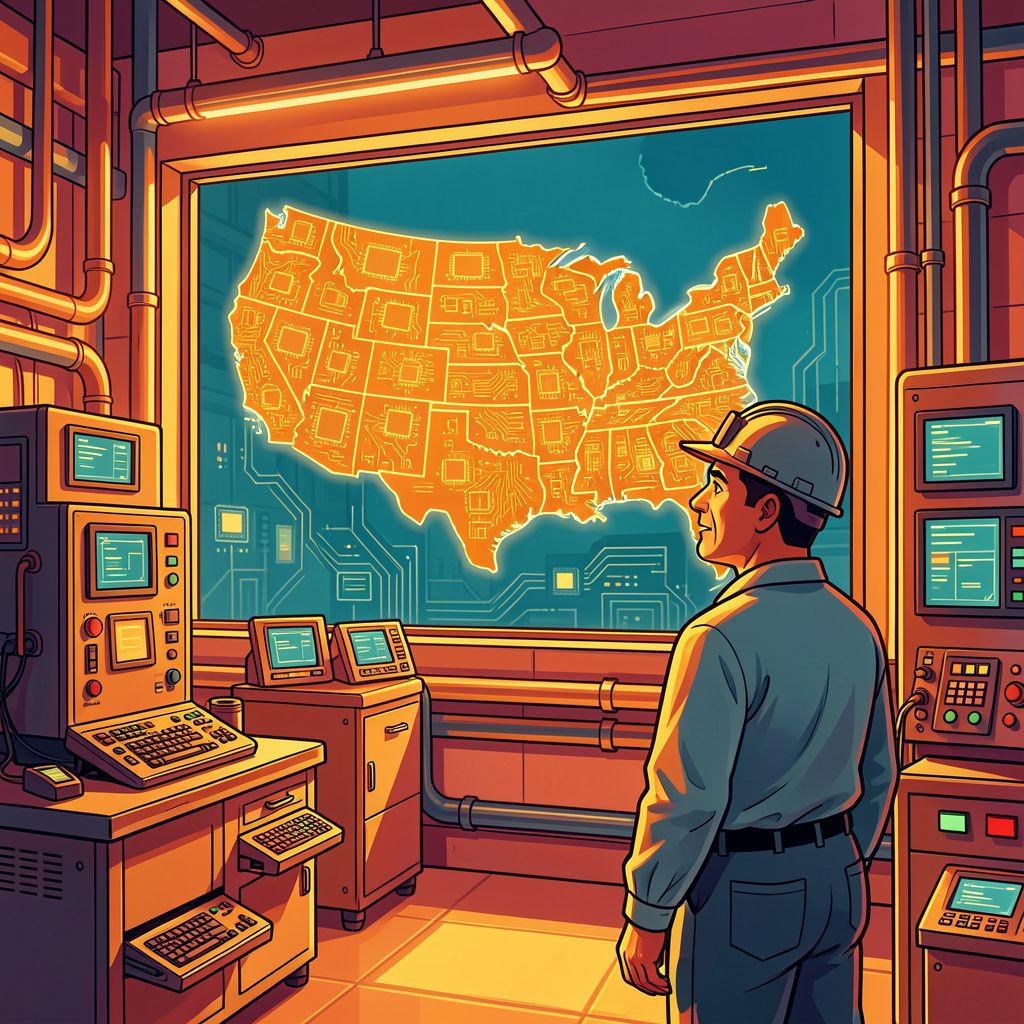
After Middle East conflicts trapped a third of global helium supplies, Washington designated the gas as critical to protect microchip manufacturing and shield advanced industries from catastrophic disruptions.
Securing Critical Semiconductor Infrastructure
The global industrial landscape faces unprecedented exposure to raw material vulnerability, positioning the semiconductor manufacturing industry—alongside quantum computing and advanced energy generation—at the center of an escalating supply chain crisis [2][3][4]. While helium is traditionally associated with consumer applications like balloons [4], the inert gas functions as a foundational manufacturing component with the lowest boiling point of any known gas [5]. In semiconductor fabrication, helium works by acting as a non-reactive, highly conductive thermal transfer agent that cools sensitive silicon wafers during processing and prevents chemical contamination during microscopic etching [GPT]. The gas is considered non-substitutable across several critical manufacturing stages, leak-detection protocols, and the maintenance of superconducting magnets [2][4][5].
Federal Designation and Strategic Financing
To prevent an industrial bottleneck, the United States Department of Energy officially classified helium as a critical material under the Energy Act of 2020 on Friday, October 23, 2026 [1][2][4]. The regulatory action was announced by U.S. Secretary of Energy Chris Wright and Assistant Secretary of Energy Audrey Robertson, both based in Washington [2]. The statutory designation unlocks direct federal financing mechanisms for primary producers and institutes strict federal supply chain monitoring [1][2][3]. Assistant Secretary Robertson highlighted that helium represents a vulnerable single point of failure in microchip and high-tech supply chains, emphasizing that domestic access directly determines future industrial competitiveness and national security [3][5]. This action makes helium the 20th critical material identified by the Department of Energy, joining fluorine as the only gases currently holding this status [3][5].
Geopolitical Chokepoints and Global Squeeze
The critical designation follows severe systemic shocks to global distribution infrastructure triggered by military conflict in the Middle East [1][3][4]. In February 2026, the closure of the Strait of Hormuz by Iran trapped roughly one-third of global helium supplies within the Persian Gulf [4]. Compounding the disruption, Iranian military strikes hit Qatar’s Ras Laffan gas facility in March 2026, severely curtailing Qatari output [1][4]. The market destabilization was further exacerbated when Russia implemented temporary helium export restrictions in April 2026 to shelter its domestic industrial base [1][3][5]. Although the United States, Qatar, and Russia rank as the top global producers of the gas—which is extracted primarily as a byproduct of natural gas refining—the concurrent global shocks have severely choked available international supplies [1][3][4].
Production Deficits and Corporate Mobilization
The global deficit poses an acute threat to downstream manufacturing regions like Europe, which banned direct imports of Russian helium in 2024 and faced secondary constraints when China implemented a temporary export ban in July 2026 [1]. In North America, the United States maintained annual production at roughly 80 million cubic meters since 2021, and produced 81 million cubic meters in 2025, representing 43 percent of global supply, while exporting 38 million cubic meters [3][5]. Domestic domestic reserves remain concentrated in states such as Wyoming, Kansas, Texas, Oklahoma, Colorado, and Utah [3][5]. Following a 2013 congressional mandate to privatize the strategic national stockpile in Texas, the Bureau of Land Management completed the formal transfer of the federal helium system to industrial gas supplier Messer in 2024 [3][5].
Sustainable Extraction and Supply Resilience
Industrial leaders and academic researchers are advancing strategic initiatives to scale up extraction and technological resilience [3][5]. Chris Bakker, Chief Executive Officer of extraction firm Avanti Helium, stated that maintaining North American self-sufficiency requires immediate capital investment in reserve exploration, a process expedited by the federal critical material listing [3][5]. Concurrently, Greeshma Gadikota, director of the Lenfest Center for Sustainable Energy at Columbia University, noted that pure helium recovery and utilization do not inherently release greenhouse gas emissions [3][5]. Gadikota advocates for processing natural gas directly into hydrogen and solid carbon to capture high-value helium cleanly, asserting that integrating refining and recovery operations within domestic manufacturing justification warrants federal capital support to insulate advanced chipmakers against foreign shocks [3][5].