

Coordinated Cyberattacks Cripple European Food Supply Chains
The Hague, Saturday, 24 October 2026.
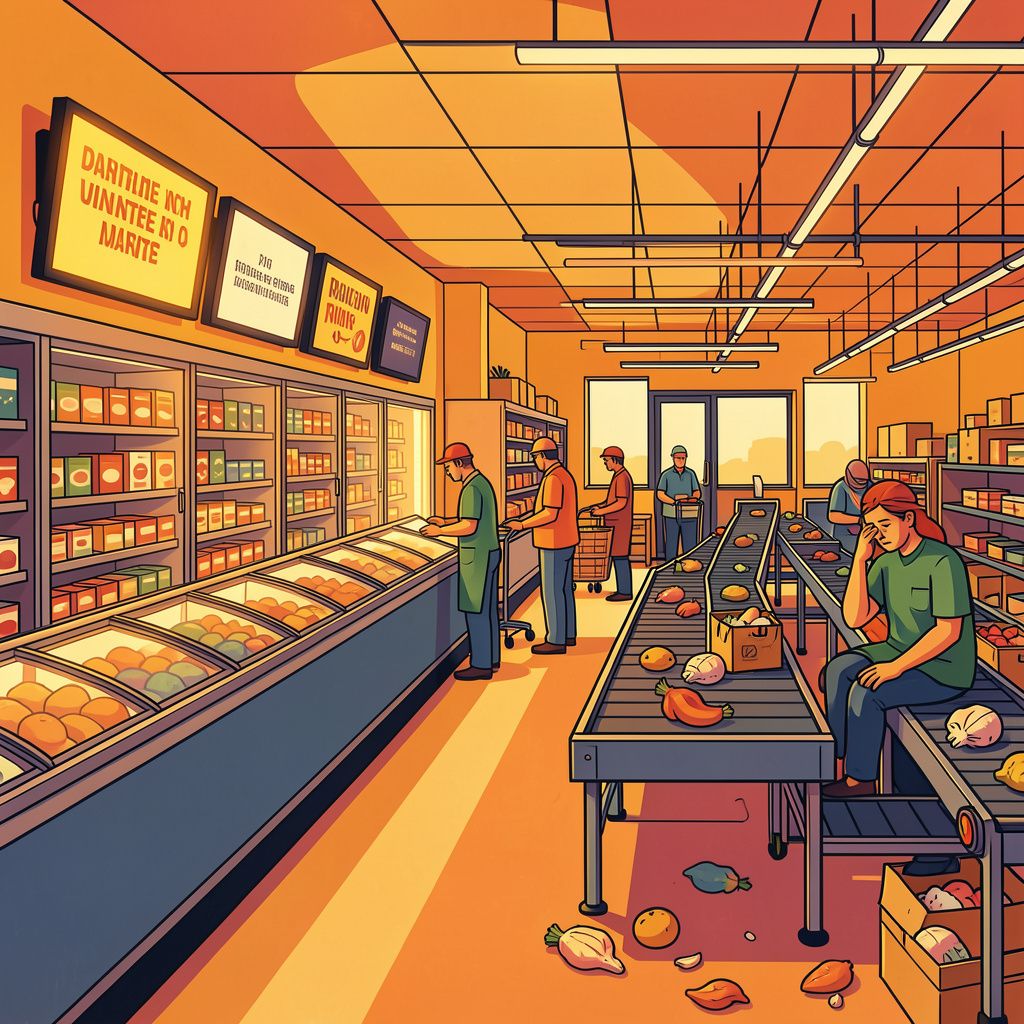
Recent cyberattacks disrupted European food networks, remotely forcing French supermarket freezers to 50 °C to spoil inventory while simultaneously halting automated deliveries and distribution for major Dutch retailers.
Remote Temperature Manipulation Destroys Inventory Across France
The incident unfolded on Monday, October 5, 2026, when cyber intruders manipulated connected refrigeration management platforms across France [4]. Attackers remotely overrode cooling settings and initiated rapid defrost cycles, pushing store freezers to temperatures as high as 50 °C [4][6][8]. This orchestrated overheating ruined fresh meat and frozen goods across major food retailers, including Intermarché, Coopérative U, Monoprix, and Carrefour [6][8]. Thierry Cotillard, president of Les Mousquetaires, estimated that at least 300 stores under his group were affected, while Coopérative U reported approximately 100 hit locations and Monoprix counted roughly 30 stores [8]. Independent reporting tallied at least 350 supermarkets suffering temperature disruptions nationwide [6], sparking multi-million-dollar inventory write-offs [8].
Legacy Firmware Flaws Expose Critical Cold-Chain IoT Infrastructure
Technical assessments led by France’s national cybersecurity agency, ANSSI, traced the point of failure to legacy vulnerabilities in automated refrigeration controllers [4][6]. The affected hardware ran software supplied by Danfoss, a Denmark-based engineering and industrial automation corporation [4][6][8], as well as Copeland and its subsidiary Dixell [6]. Cybersecurity researchers pointed out that although security company Claroty detailed critical vulnerabilities in older firmware versions in August 2026, which vendors subsequently patched, thousands of operational facilities failed to apply updates [6]. Onyphe identified that outdated firmware interfaces remained widely exposed to the public internet, with Reuters tallying at least 4,500 Danfoss interfaces directly accessible online [6]. Danfoss emphasized that many breached controllers were end-of-life systems operating without security maintenance, urging clients to migrate legacy networks to modern, supported architectures [1][4][6].
Dutch Logistics Halt as Just-in-Time Networks Disconnect
Simultaneously, a distinct cyber incident hit the Dutch food retail conglomerate Ahold Delhaize, paralyzing commercial distribution in the Netherlands, Belgium, and Luxembourg [4][8]. IT networks and logistics links exhibited failures as early as Saturday, October 10, 2026, forcing automated hubs in Zaandam and Utrecht to a standstill [3]. In response, corporate management made a proactive ‘business decision’ to disconnect operational networks and pull consumer websites, mobile applications, and home deliveries offline ‘as a precautionary measure’ [1][8]. While physical Albert Heijn supermarkets remained open, chief executive Margaret Versteden-Van Duijn warned that automated fulfillment delays risked leaving shelves empty, particularly in fresh produce sections [8]. Customers simultaneously faced disruptions at self-checkout registers and electronic price-tag updates [4][8].
Geopolitical Scrutiny and Future Supply Chain Resilience
The simultaneous disruption across France, the Netherlands, and Belgium has magnified concerns over food security as critical infrastructure [4][8]. Broadcaster NOS reported that Dutch network analysts traced attack traffic through intermediate servers located across the United States, Poland, Moldova, and Turkey, while the Dutch National Cyber Security Centre (NCSC) indicated it had found no direct operational link connecting the Dutch breach to the French freezer attacks [6]. European Commissioner for Agriculture Christophe Hansen cautioned that the weaponization of civilian food logistics is becoming a reality, while French Prime Minister Sébastien Lecornu instructed ANSSI to pursue extensive forensic investigations [4][8]. With French President Emmanuel Macron having ordered heightened national infrastructure protections in September 2026, European logistics operators face tightening regulatory scrutiny—including forthcoming CIRCIA requirements obligating critical infrastructure firms to disclose cyber incidents within 72 hours [1][4].
Bronnen
- www.wiley.law
- www.reuters.com
- www.instagram.com
- www.theguardian.com
- www.facebook.com
- www.euronews.com
- www.youtube.com
- en.ara.cat