

How Industrial Steel Waste Could Power Europe's Clean Energy Storage
Haarlem, Friday, 16 October 2026.
Dutch startup Phoenix Metals is extracting battery-grade vanadium from steel waste. This innovation could supply one-third of Europe’s demand, significantly cutting reliance on Chinese imports.
Transforming Industrial Byproducts into Clean Energy Assets
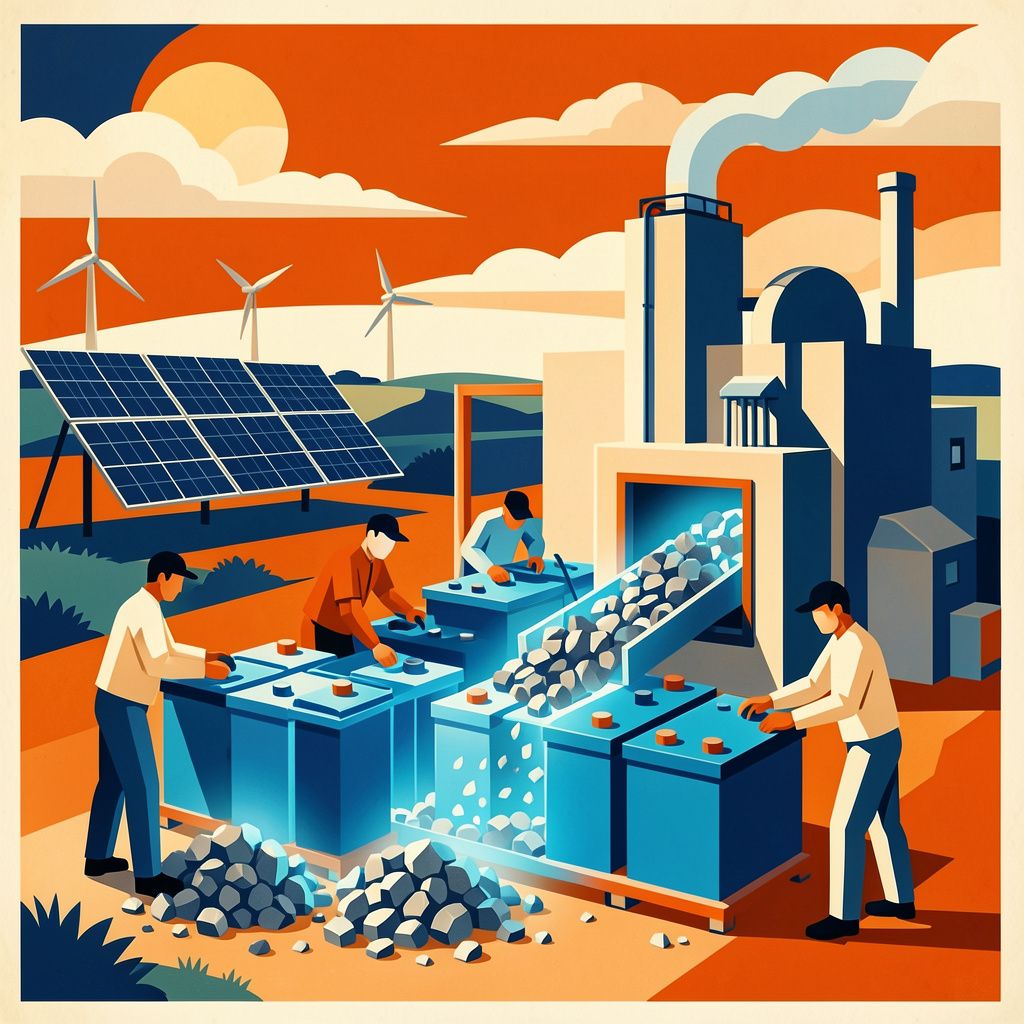
As Europe accelerates its clean energy transition, securing critical raw materials without relying on foreign supply chains has become an urgent strategic imperative [1][GPT]. Founded in 2020 by Gijsbert Bakker and Stijn van Zelst, the Dutch startup Phoenix Metals is tackling this supply chain vulnerability directly from IJmuiden, North Holland [1][2]. Originally launched following an exploratory mining project in South Africa and a discovery in Dutch industrial residue, the company pivoted its core focus in 2023 toward recovering high-value metals from steel slag—a major byproduct of crude steel production [1][2]. Using hydrometallurgical processing, Phoenix Metals extracts vanadium alongside iron, calcium, magnesium, and manganese to produce vanadium electrolyte, a crucial element for long-duration energy storage [1].
Addressing Europe’s Vanadium Supply Deficit
The economic rationale for localized metal recovery is compelling. Currently, Europe imports 95% of its vanadium, primarily from China [1]. However, domestic industrial byproducts offer substantial untapped potential: Tata Steel Nederland alone produces approximately 650,000 tonnes of steel slag annually [2]. Across Europe, steel manufacturing leaves behind an estimated 16 million tonnes of slag each year [5]. Industry evaluations indicate that Dutch steel slag alone contains enough recoverable vanadium to meet approximately one-third of total European demand [1], offering a direct pathway to enhance raw material independence [1][GPT].
The Strategic Role of Vanadium-Flow Batteries
The material extracted by Phoenix Metals feeds directly into the production of vanadium redox flow batteries [1]. Unlike lithium-ion batteries—which dominate electric mobility—vanadium-flow batteries are non-flammable, offer extended operational lifespans, and are fully recyclable, making them optimal for stationary grid storage, industrial clusters, and data centers [1]. Beyond vanadium, the startup’s multi-output hydrometallurgical recovery process ensures that the entire waste stream yields commercial value, improving economic viability compared to traditional single-stream recycling systems [1].
Scaling Up: From IJmuiden Pilot to Commercial Operations
Transitioning complex hydrometallurgical concepts into commercial realities requires capital and demonstrated scale [1][2]. To bridge this gap, Phoenix Metals secured €4 million in seed funding from regional development agencies InnovationQuarter and ROM InWest, alongside Mossinkoff Investments [2][3]. The company is currently constructing a pilot plant in IJmuiden designed to process 500 tonnes of steel slag annually [2]. This facility will generate technical data and validation samples for prospective industrial clients, serving as the foundational stepping stone toward establishing full commercial production by 2031 [1][2].
Bronnen
- rominwest.nl
- www.innovationquarter.nl
- nl.linkedin.com
- groenechemie.nl
- heilooenergie.nl
- www.change.inc
- groenechemie.nl
- www.change.inc