

Dutch Startup Raises Millions to Pay Consumers for Recycling Household Waste
Haarlem, Friday, 9 October 2026.
Droppie secured 4.2 million euros to expand its network to 70 stores, using AI-driven machines to identify, weigh, and instantly pay consumers for recycling household waste.
Addressing the Urban Waste Crisis
In the Netherlands, waste management remains a significant environmental hurdle, with the average Dutch citizen producing 490 kg of waste annually [1]. Despite national sustainability goals, only 60% of this household waste is correctly separated [1]. This issue is particularly acute in densely populated urban areas, where high-rise housing, a lack of convenient infrastructure, and unclear instructions often lead to poorly sorted waste streams and illegal dumping next to public collection bins [1]. To combat this, the Amsterdam-based startup Droppie has introduced a network of physical, community-centric recycling hubs designed to make circular habits both simple and financially rewarding [1][2].
The Dropbot AI and Rewarded Recycling
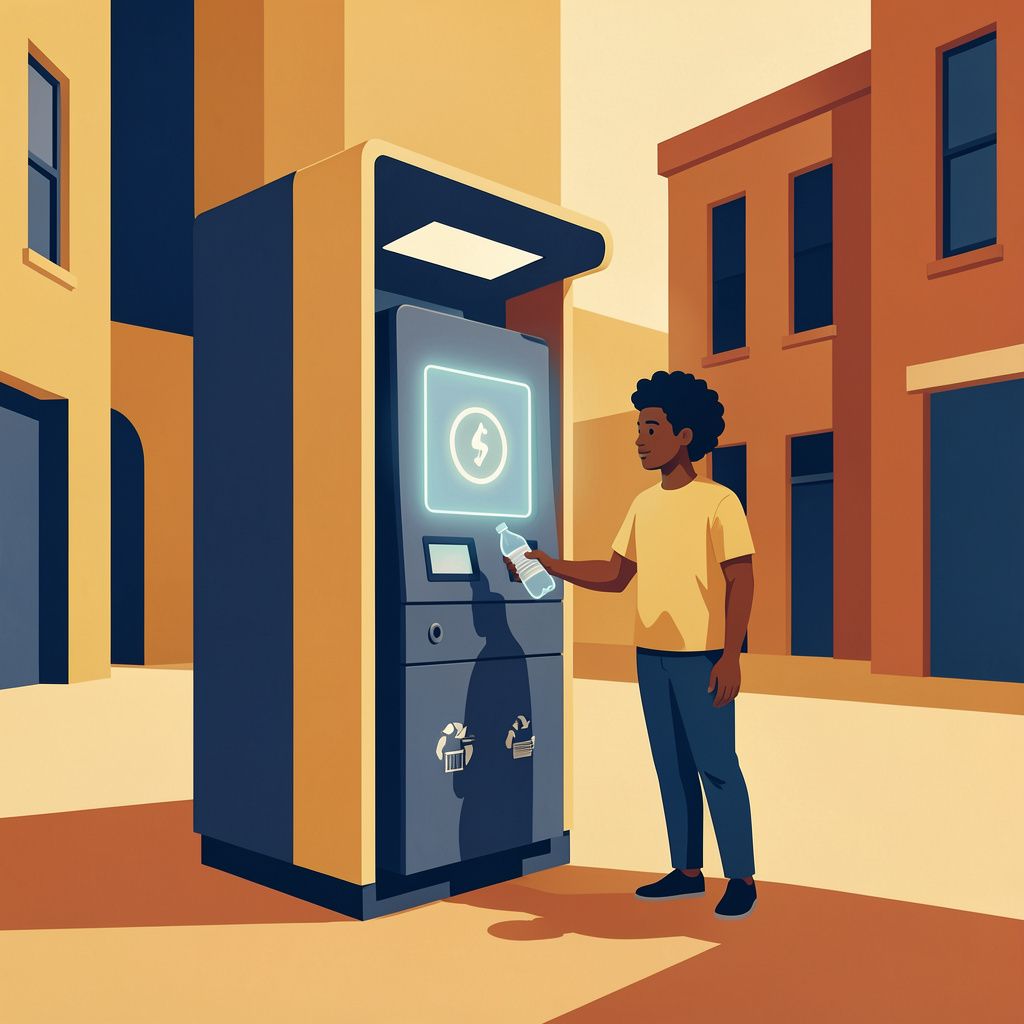
At the core of Droppie’s operational model is the “Dropbot,” an artificial intelligence-driven intake machine [1]. When consumers bring sorted household waste—including plastic packaging, textiles, frying fat, used cooking oil, electronics, and deposit-refund containers—to a Droppie store, the Dropbot uses advanced image recognition to classify and weigh the materials [1]. The system then automatically calculates and distributes a financial reward to the user via the Droppie app [1][2]. Participants can choose to keep this monetary incentive or donate it directly to charity [1]. This gamified, high-tech approach has already driven significant engagement, attracting more than 85,000 participating households and facilitating over 510,000 drop-off events [3].
Scaling Up with €4.2 Million in Growth Capital
To scale this circular framework, Droppie secured €4.2 million in growth capital in June 2026 [3]. The funding round was supported by a consortium of prominent impact investors, including regional development agency ROM InWest, the Amsterdam Climate & Energy Fund (AKEF), the Start Foundation, the Social Impact Fund Rotterdam and Amsterdam (SIF), and Dutch Dragons crowdfunders [2][3]. This capital injection is earmarked to expand Droppie’s physical footprint from 13 to 70 locations across the Netherlands, representing an ambitious location growth rate of 438.462% [1][3]. The expansion will focus heavily on large municipalities utilizing post-separation systems, as well as the country’s four largest cities, where urban waste separation historically lags behind [1].
Environmental Benefits and Material Security
By capturing high-quality, source-separated materials, Droppie directly addresses the scarcity of premium recycled plastics [1]. Lotte Nolten-van Hoek, Investment Manager at ROM InWest, highlighted that high-quality recycled plastic remains expensive and scarce due to inefficient collection systems [1]. Droppie’s clean material streams allow recycled polymers to directly substitute virgin crude oil in manufacturing, fostering greater resource independence and lower industrial carbon footprints [1]. To date, Droppie has successfully diverted nearly 650,000 kg of recyclable material from incinerators, in addition to processing more than 15 million deposit-refund items [3].
Synergy in Logistics: The DPD Partnership
In a bid to seamlessly integrate recycling into daily consumer routines, Droppie launched a strategic partnership with logistics giant DPD Netherlands on October 1, 2026 [3]. Active through January 31, 2027, this pilot program merges parcel shipping and pickup services with recycling collection at 10 Droppie locations [3]. Under this initiative, customers earn digital stamps in the Droppie app for sending or receiving DPD parcels, with 10 stamps earning them a limited-edition “DPD × Droppie Bring it BAG” [3]. Droppie co-founder Stef Traa emphasized the convenience of this dual-purpose trip, noting that aligning recycling with everyday tasks like picking up a package makes sustainable living effortless and rewarding [3].
Stepping Stones Toward Net Zero
For DPD Netherlands—a subsidiary of Geopost operating 12 local depots and managing a capacity of 750,000 parcels per day across the Benelux region—the collaboration aligns with its corporate mandate to achieve Net Zero emissions by 2040 [3]. In 2025, Geopost processed 2.2 billion parcels globally while successfully lowering its greenhouse gas emissions by 1.6% to 1.71 million tonnes of CO2 equivalent [3]. Cédric Favre-Lorraine, CEO of DPD Netherlands, stated that partnering with Droppie represents a highly practical step toward making sustainable daily choices accessible and intuitive for consumers, proving that micro-incentives can drive macro-level circular transitions [3].