

Activists Storm Amsterdam Data Center as Backlash Against Tech Infrastructure Spreads
Amsterdam, Friday, 6 November 2026.
European demonstrators breached a Microsoft construction site to demand building halts, highlighting mounting conflicts between rapid artificial intelligence investments and critical public resources like power and water grids.
Tensions Escalate at Amsterdam Construction Hub
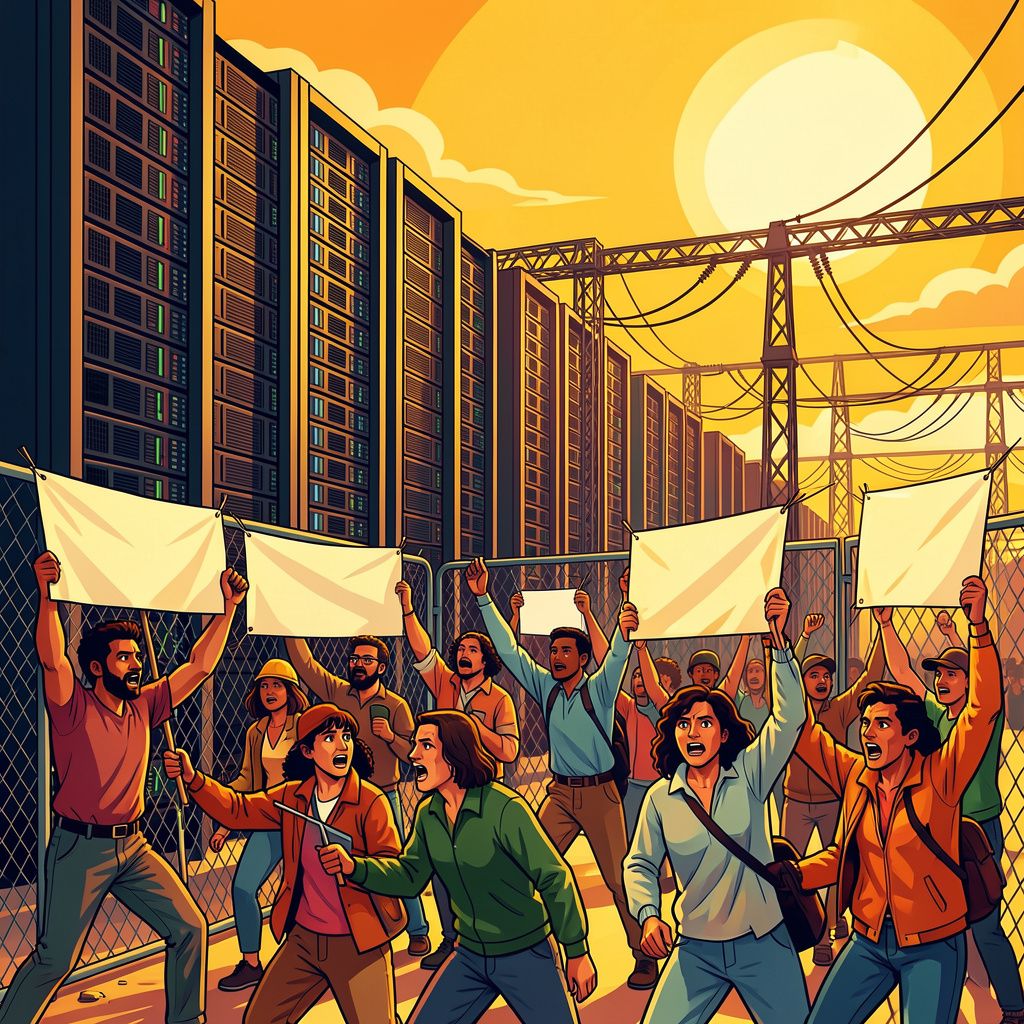
A targeted confrontation unfolded on the outskirts of Amsterdam, Netherlands, when more than 100 demonstrators marched arm in arm and breached the active construction site of a Microsoft data center [1][2][4]. Some demonstrators scaled towering construction cranes, hung balloons, set off flares, and danced carrying signs reading “Screw your data center” [1][2]. The confrontation led to direct clashes with law enforcement, who deployed pepper spray against hooded demonstrators [1][2]. Dutch police ultimately detained between 150 and 200 individuals on suspicion of trespassing at the facility grounds [2].
Corporate Stakes and Infrastructure Ownership
The physical real estate project is spearheaded by site owner Pure Data Centres, which plans to inject more than $1 billion (€890 million) into the complex to support high-performance hyperscale operations [1]. Following the security breach, Pure Data Centres appealed to activists to exit the grounds safely to hold structured discussions regarding environmental and community impacts [1]. Meanwhile, multinational tech titan Microsoft clarified that while it respects peaceful civic expression, it refuses to condone unlawful behavior or safety threats [1][2]. Local activists such as Nathan Timmer from the campaign group Geef Tegengas argued against the fundamental necessity of the site, alleging that the capacity would primarily fuel automated surveillance, warfare, and generative slop, whereas demonstrator Sam van der Beek warned that the compounding resource consumption of computing facilities renders local habitats unlivable [1][2].
Coordinated Pushback Across European Borders
The disruption in Amsterdam represents the vanguard of a broader wave of civil resistance orchestrated by the Stop Dirty Data Centres grassroots coalition, which organized multi-nation demonstrations spanning 15 to 16 countries including Ireland, Poland, Denmark, Finland, Spain, Italy, the Netherlands, France, and the United Kingdom [1][2]. Grassroots actions gained traction leading up to the breach; on Friday, October 30, 2026, a dozen activists assembled outside a facility near Berlin, Germany, while approximately 100 people picketed Poland’s parliament in Warsaw [2]. The momentum follows a major mobilization on October 10, 2026, where over 1,000 citizens and roughly 40 civic committees rallied in Milan’s Piazza della Scala, Italy, demanding an immediate moratorium on regional hyperscale building approvals [2].
The Resource Dilemma Behind Cloud and AI Innovation
At the center of the dispute is the foundational architecture of cloud computing and modern artificial intelligence, which relies on expansive arrays of interconnected servers and graphics processing units operating continuously inside specialized facilities [GPT]. This computational innovation automates enterprise analytics, powers large generative models, supports state digital infrastructure, and provides essential data processing for businesses, governments, and end consumers globally [1]. However, running high-density workloads generates immense heat and electrical loads, requiring vast quantities of cooling water and sustained baseload power that strain municipal grids, crowd out affordable housing, and threaten municipal decarbonization goals [1].
Regulatory Headwinds and Capital Reallocation
The pushback occurs alongside widening legal and policy constraints across the continent. In Finland, a Google data center development has been subjected to a criminal investigation regarding land clearing, while national authorities in Italy and Portugal are drafting more stringent environmental limits [1]. The domestic Dutch market already counts approximately 200 facilities operating, under construction, or planned, intensifying public scrutiny over local spatial planning [1]. Stop Dirty Data Centres coordinator Owen Espley emphasized that a substantial disconnect exists between public priorities and political leaders caught up in technology hype, noting that the coalition seeks comprehensive national regulatory guidelines rather than retroactively shuttering existing digital operations [1][2].
Long-Term Financial Commitments Face Mounting Scrutiny
The friction arrives amid massive long-term capital deployment projected for global computational assets. Industry projections from PwC’s Global Data Centre Outlook 2026–50 estimate that Europe will attract $5.6 trillion—representing an 18% share of cumulative global capital expenditure—between 2026 and 2050, while the United States is anticipated to capture $15.1 trillion [2]. Based on these projections, the United States is slated to receive 9.5 trillion more in capital expenditure than Europe over this period [2]. As technology developers navigate mounting civic pushback and tightening environmental oversight, bridging the gap between hyperscale computing ambitions and resource conservation has emerged as the defining operational hurdle for European digital infrastructure [1][2].