

Unlocking Recycled Fertilizer Potential to Protect Crops from Drought
Wageningen, Tuesday, 3 November 2026.
Backed by NWO Vidi funding, new research explores how earthworms and soil microbes help crops absorb recycled wastewater phosphorus, offering farmers vital drought resilience amid finite mineral supplies.
Agritech Innovation Addressing Agricultural Vulnerability
Representing a critical breakthrough in the field of agritech, this initiative targets the intersection of nutrient circularity and climate adaptation [1][4]. The innovation is spearheaded by Dr. Alix Vidal, a soil biologist from the Soil Biology Group at Wageningen University & Research (WUR) [1][4]. Operating out of Wageningen in the Netherlands, Dr. Vidal is leading the project titled UP-LIFE—short for ‘Unlocking the Power of Soil Life for Future-proofing Crops’ [1][4]. The primary objective is to resolve a systemic supply vulnerability: European agriculture remains heavily dependent on imported phosphate rock, a finite natural resource, even as vast quantities of phosphorus are lost downstream in municipal and agricultural waste streams [1][4].
Unlocking Struvite via Biological Mechanisms
The technology at the center of the project is struvite, a circular, recycled fertilizer mineral recovered directly from wastewater streams [1][4]. While struvite represents an environmentally sustainable alternative to synthetic and mined inputs, it presents operational hurdles: it dissolves and releases phosphorus relatively slowly, an issue substantially aggravated during water-scarce periods [1][4]. Farmers have consequently remained cautious about incorporating struvite into their agronomic cycles as intensifying climate change makes severe droughts increasingly frequent across Europe [1][4]. Dr. Vidal’s work pivots away from conventional chemical solutions, shifting focus directly to subterranean biology to discover how belowground ecosystems can unlock nutrients trapped in recycled inputs [1][4].
The Mechanics of the UP-LIFE Experimental Framework
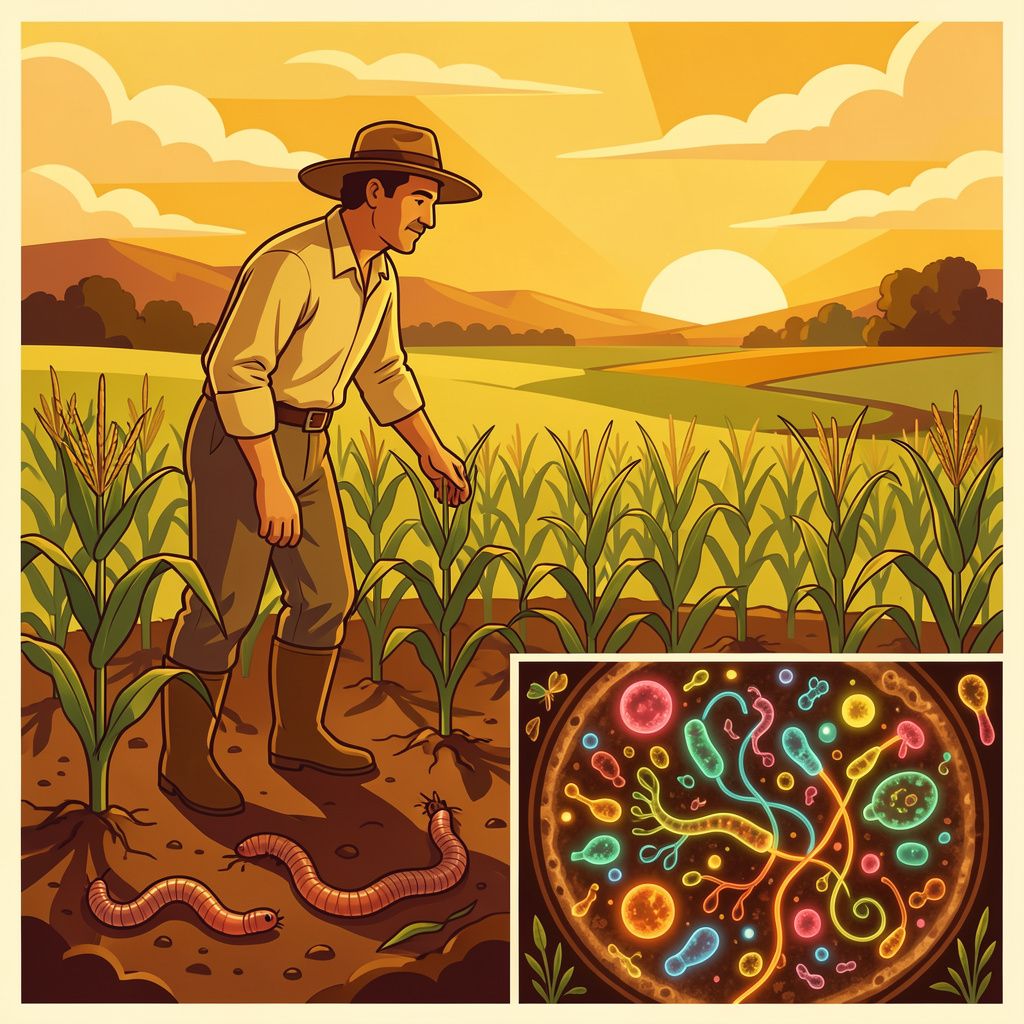
The innovation functions by mobilizing natural biological interactions to accelerate phosphorus release and plant uptake when soil moisture is severely restricted [1][2][4]. To achieve this, the UP-LIFE framework evaluates the symbiotic behaviors between plant roots, microbial consortia, mycorrhizal fungi, and earthworms [1][2][4]. Historically, research on recycled fertilizers has concentrated primarily on abiotic soil chemistry [1][4]. Dr. Vidal’s approach instead maps how living organisms actively modify the soil environment around root zones, making slow-release phosphorus bioavailable even during periods of water scarcity [1][2][4]. The project will integrate multi-tier laboratory experiments, controlled field trials, advanced isotope tracing, and predictive computer modeling [1][4].
Commercial and Operational Benefits for Resilient Agriculture
The predictive computer models generated by the project will establish benchmarks indicating exactly when, where, and under which environmental variables struvite can be deployed as an effective fertilizer substitute [1][4]. By clarifying these parameters, the research equips farmers and circular agribusinesses with actionable data, de-risking the transition away from depleting mineral reserves toward recycled wastewater nutrients [1][4]. By lowering exposure to geopolitical phosphate price shocks and shielding yields against recurrent droughts, the project provides a biological buffer that supports sustainable crop production and reduces dependence on imported synthetic inputs [1][4].
Grant Backing and Research Expansion Across Wageningen
Financial support for this initiative was formally announced in October 2026, when the Dutch Research Council (NWO) awarded Dr. Vidal a prestigious Vidi grant [2][5]. Providing funding of up to 850,000 euros, the grant enables Dr. Vidal to establish a dedicated research team and supervise two doctoral candidates [1][3][4][5]. The Vidi grant round awarded a total of 109 grants nationwide across science, engineering, social sciences, and health domains [3][5]. Wageningen University & Research achieved a record institutional tally of eight Vidi recipients, placing WUR alongside Utrecht University and both Amsterdam universities, while Delft University of Technology secured 13 [3][5]. Across the competitive funding cycle, 109 awards were granted from an initial applicant pool of 712 researchers, of whom 265 had been invited to submit full proposals [5].
Demographics and Institutional Knowledge Integration
The 2026 NWO Vidi funding round achieved an overall proposal success rate of 15.309 percent [5]. Success rates reflected significant demographic milestones: women recorded a 19 percent success rate compared to 12 percent for men, with six of WUR’s eight successful grants awarded to female principal investigators—a first in the university’s institutional history [5]. Alongside Dr. Vidal’s work in soil biology and drought nutrition, other WUR Vidi projects investigate critical ecological challenges, including Dr. Stephanie Watts-Fawkes’s research into fungal transmission pathways of PFAS pollutants into crops and Dr. ir. Inge de Graaf’s SAFE-GROUND initiative examining groundwater reserves during prolonged droughts [3][5][7][8]. Beyond laboratory benchmarks, Dr. Vidal will incorporate insights from the UP-LIFE project directly into agricultural degree curricula at Wageningen University, ensuring next-generation agronomists integrate soil biology into climate-resilient farming [1][4].
Bronnen
- www.wur.nl
- www.linkedin.com
- www.wur.nl
- www.miragenews.com
- www.resource-online.nl
- www.linkedin.com
- www.miragenews.com
- www.myscience.co.nl