

Transforming Industrial Waste Into Strategic European Battery Minerals
IJmuiden, Sunday, 1 November 2026.
Securing a €4 million investment, Phoenix Metals is building a Dutch facility to extract critical minerals from industrial slag, targeting Europe’s massive 95% reliance on foreign vanadium supplies.
Scaling Urban Mining in IJmuiden
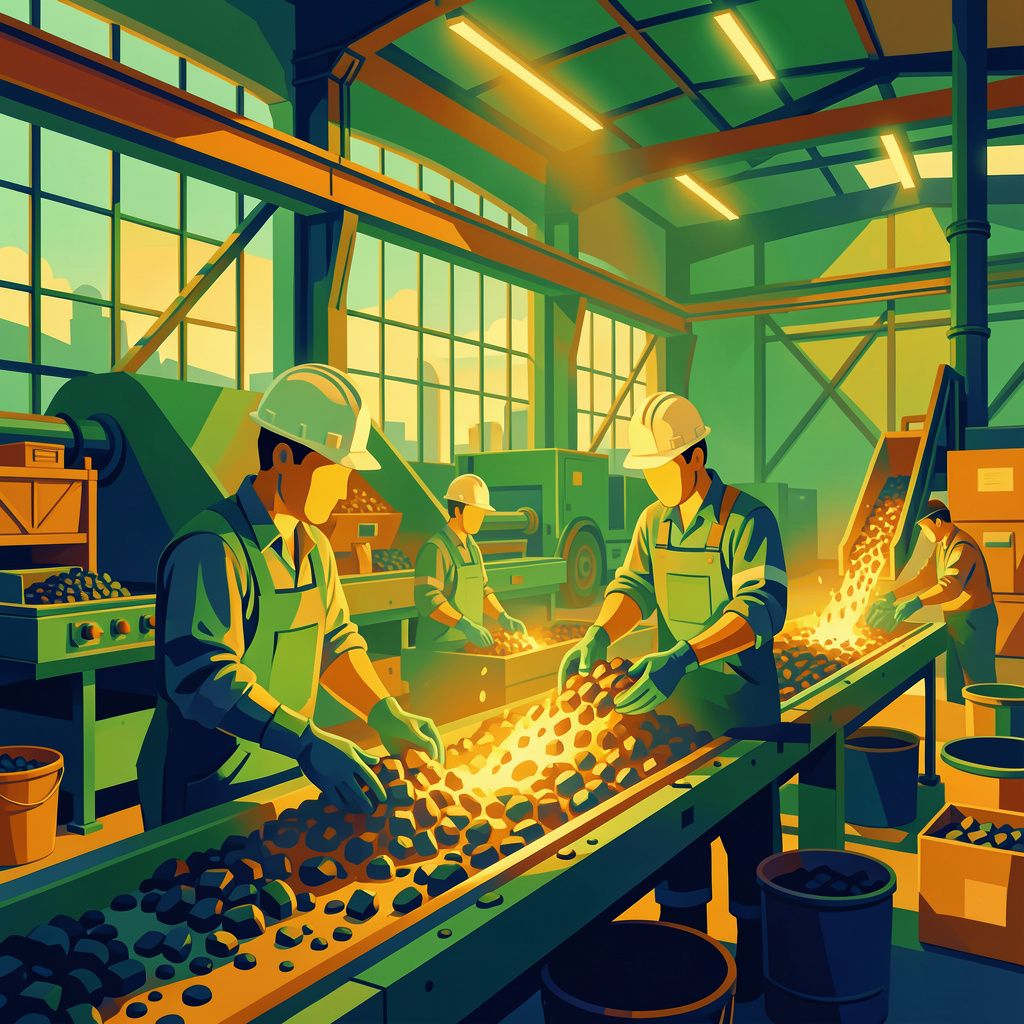
The Dutch deep-tech and urban mining startup Phoenix Metals, led by founders Gijsbert Bakker and Stijn van Zelst, is establishing a specialized pilot facility in IJmuiden to process 500 metric tons of industrial byproduct into critical raw materials [1]. Backed by regional development agency ROM InWest, which supports innovative ventures across North Holland [1][4], the venture deploys low-temperature hydrometallurgical technologies designed to process complex feedstocks, including steel slag, refinery residues, and maritime waste [1]. Conventional recycling methodologies in metallurgy have historically operated on selective extraction, targeting only a single high-value metal while discarding residual compounds [1]. In contrast, Phoenix Metals’ technological process focuses on complete valorization, targeting the recovery of vanadium alongside secondary fractions of iron, magnesium, manganese, calcium-based products, and other mineral components directly from industrial slag [1].
Strengthening European Strategic Autonomy
The push to scale urban mining addresses acute supply chain vulnerabilities across the continent, where European industry currently imports 95% of its vanadium requirements [1]. Vanadium is designated as an indispensable input for vanadium redox flow batteries, an electrochemical storage architecture increasingly relied upon for utility-scale energy storage across power grids, renewable power generation sites, industrial complexes, and data centers [1]. Phoenix Metals notes that domestic secondary extraction directly bolsters European strategic autonomy while facilitating the continent’s green energy transition [1]. By substituting emissions-intensive primary mining extraction with closed-loop hydrometallurgical recycling, secondary mineral production substantially curtails regional carbon emissions and industrial waste volumes [1][GPT].
Blending Public Subsidies and Private Capital
Phoenix Metals’ €4 million seed round forms part of a broader capital structure that combines private venture equity with regional and European public grants [1]. Prior to closing this seed financing, the enterprise secured more than €5 million in non-dilutive subsidies [1], bringing total financial backing across both sources to 9 million euros. This grant capital was awarded by the European Just Transition Fund, the provinces of North Holland and South Holland, the Netherlands Enterprise Agency (Rijksdienst voor Ondernemend Nederland - RVO), and Kansen voor West [1]. Reynier de Monchy, Senior Investment Manager at ROM InWest, emphasized that pairing proprietary chemical processing with the IJmuiden pilot site directly contributes to resilient, circular industrial supply chains in the regional ecosystem [1].
The Broader Landscape of Critical Material Innovation
The industrial scaling efforts in IJmuiden reflect an accelerating global trend toward domestic resource circularity and battery ecosystem development [1][2]. While European initiatives concentrate on chemical slag valorization to satisfy raw material needs, comparable critical materials hubs are scaling internationally, such as in Nevada where industry participants like Dragonfly Energy, Echo Elements, and Redwood Materials focus on localized battery materials recovery and recycling ecosystems [2]. As Phoenix Metals scales its pilot towards full continuous operations, the integration of public-sector de-risking mechanisms with regional venture capital offers an operational framework for securing critical battery supply chains while addressing longstanding industrial pollution challenges [1][4].