
Turning Industrial Waste Into Critical Battery Metals
IJmuiden, Monday, 23 November 2026.
Phoenix Metals raised €4 million to build a pilot facility processing 500 tons of steel slag, extracting critical vanadium to reduce Europe’s 95% import dependence for clean energy storage.
Scaling Urban Mining in IJmuiden
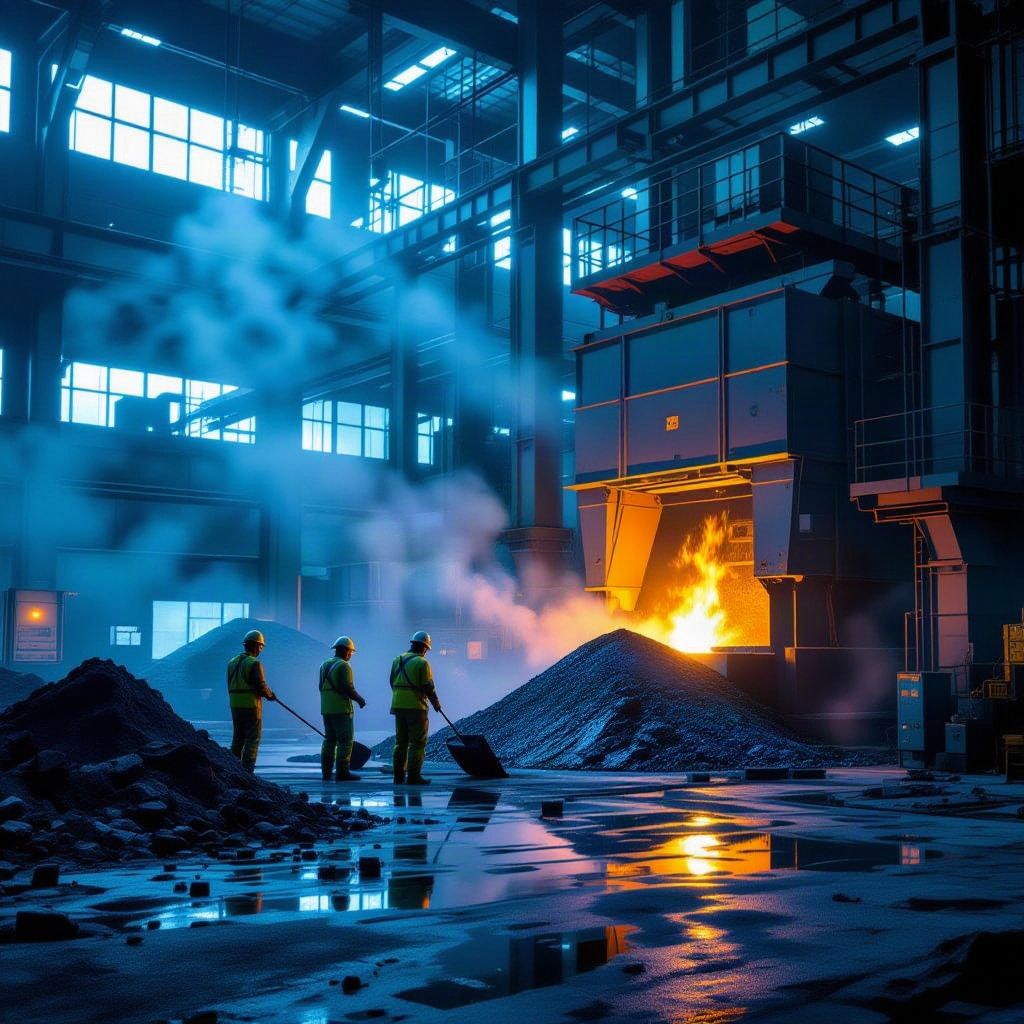
The Dutch deep-tech and circular metallurgy venture Phoenix Metals, led by co-founders Gijsbert Bakker and Stijn van Zelst, is establishing a pilot plant in IJmuiden [1][2]. Phoenix Metals operates in IJmuiden to process industrial residues, tackling raw material recovery directly at the source by targeting byproducts such as steel slag from the local Tata Steel operations, refinery residues, and maritime waste streams [1][2][3]. The €4 million seed round announced in mid-November 2026 was backed by regional development agency ROM InWest alongside InnovationQuarter and private investor Mossinkoff Investments [1][2][4]. This fresh equity injection enables the enterprise to construct and scale an installation engineered to treat 500 tons of industrial waste into valuable secondary raw materials [1][4].
Unlocking Full-Stream Hydrometallurgical Extraction
Rather than relying on energy-intensive, conventional recycling techniques that isolate only a single high-value element, Phoenix Metals utilizes low-temperature hydrometallurgical technologies designed to valorize entire material flows [1]. In processing steel slags, the startup isolates critical elements including vanadium, iron, magnesium, manganese, calcium-based derivatives, and reusable mineral fractions [1]. Bakker, who serves as CEO, noted that the core developmental hurdle lies in scaling up the industrial chemical process while effectively articulating the venture’s market trajectory to investors [2].
Addressing European Raw Material Vulnerabilities
Phoenix Metals’ technological deployment directly targets European supply security in critical raw materials [1][3]. Currently, Europe imports 95% of its vanadium, exposing industrial supply chains to external geopolitical disruptions [1]. The recovered vanadium is pivotal for the deployment of vanadium redox flow batteries, which provide scalable long-duration energy storage vital for stabilizing electrical grids, powering regional data centers, supporting industrial clusters, and integrating intermittent renewable power generation [1][GPT]. By seeking to expand its processing framework across all European steel slags, the company addresses both environmental waste remediation and clean energy storage demands [1][3].
Public-Private Capital Synergy and Ecosystem Scaling
The €4 million seed financing complements over €5 million in research, development, and transition subsidies that Phoenix Metals secured from public programs [1][2]. These public funds comprise grants from the European Just Transition Fund, the provinces of Noord-Holland and Zuid-Holland, the Netherlands Enterprise Agency (Rijksdienst voor Ondernemend Nederland or RVO), and Kansen voor West [1]. Combined, the venture has mobilized total financial backing of 9 million euros across private investments and non-dilutive grant capital [1][2].
Regional Accelerators Shaping Sustainable Industry
Phoenix Metals’ path toward commercialization was refined through its involvement in the Green Chemistry Accelerator (GCA) program, an initiative organized by Groene Chemie, Nieuwe Economie (GCNE) alongside Invest-NL, Scale-up Practitioners, GIRTD, and regional agencies such as ROM InWest, InnovationQuarter, and LIOF [2][3]. The startup graduated from the accelerator’s fourth cohort in IJmuiden on October 8, 2025, alongside circular innovators FoamBloxx, Back to Battery, and Alkyl Recycling [2]. Reynier de Monchy, Senior Investment Manager at ROM InWest, emphasized that backing Phoenix Metals anchors critical metallurgical capacities within the North Holland region, turning hazardous industrial waste into resilient supply chains required for the broader green transition [1].